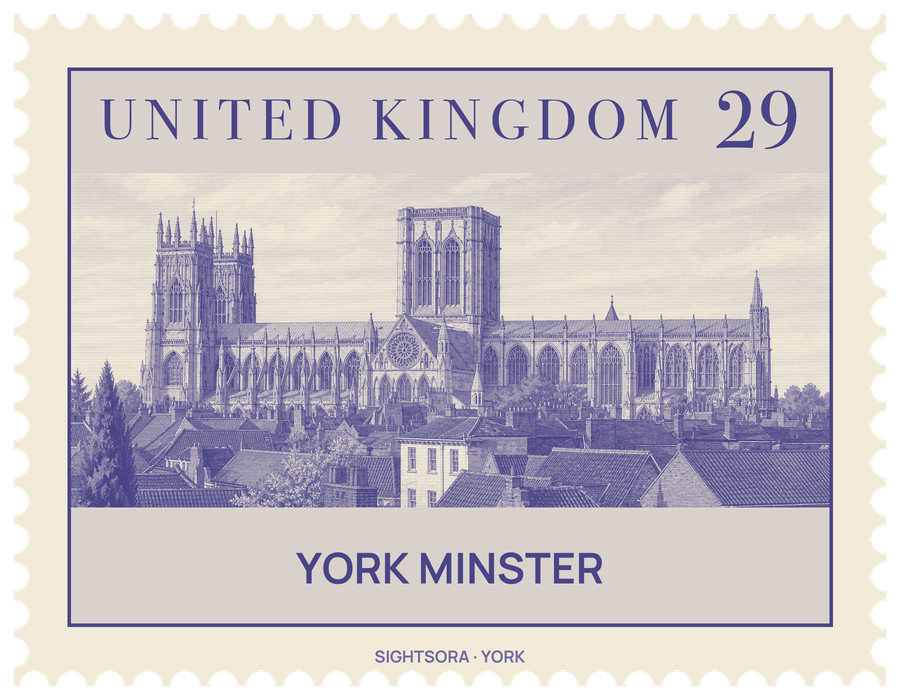
A church has stood here or close by since 627, when a hurried wooden building was put up for the baptism of Edwin, King of Northumbria. The present cathedral, of creamy-white magnesian limestone quarried at nearby Tadcaster, went up mostly between the 13th and 15th centuries and declared complete and consecrated in 1472. It is 159.9 metres long, and its central tower rises to 72 metres.
Because it went up over some two and a half centuries, the building reads like a textbook of English Gothic. The north and south transepts came first, in the Early English style with plain lancet windows; the nave and the octagonal chapter house followed in the Decorated style; and the eastern arm and central tower were finished in the Perpendicular style. The chapter house has no central column, since its light timber roof rests on the buttressed walls, and its windows fill almost the whole upper wall. Above the canopies of its seats runs a crowd of carved heads, human, angelic, animal and grotesque, some of them pulling faces.
The minster's chief treasure is its medieval stained glass, most of which it has kept; in all, some two million pieces of glass make up its windows. The Great East Window, designed by John Thornton from 1405, is 23 metres tall and shows scenes from the Book of Revelation; its 311 panels were taken out in 2008 for a conservation project completed in 2018. In the north transept, the Five Sisters are five lancets 16.3 metres high, filled with grey grisaille glass instead of pictures, while the Great West Window of 1338–39, called the Heart of Yorkshire, has flowing curvilinear tracery. The rose window in the south transept, with glass from about 1500, celebrates the joining of the royal houses of Lancaster and York.
Between the choir and the nave stands the 15th-century choir screen, lined with statues of English monarchs, beginning with William the Conqueror and ending with Henry VI, set against a red background, with the organ above it. Beneath the minster, excavations made while the foundations were strengthened after a 1967 survey uncovered part of the headquarters of the Roman fort of Eboracum below the south transept, and these remains, with those of the Norman cathedral, form part of an exhibition on how the minster was built. The building has survived several fires: in 1984 a fire destroyed the roof of the south transept, and the rebuilt roof includes new bosses designed by winners of a competition run by the children's television programme Blue Peter.
The two west towers hold the bells, including Great Peter, which strikes the hour, while the clock bells chime the quarters through the day; a carillon of 35 bells is played before Evensong. Outside, the carvings around the great west door were renewed in 2002 with new sculptures telling the Genesis story, and in 2022 a statue of Queen Elizabeth II was unveiled in a niche on the west front.