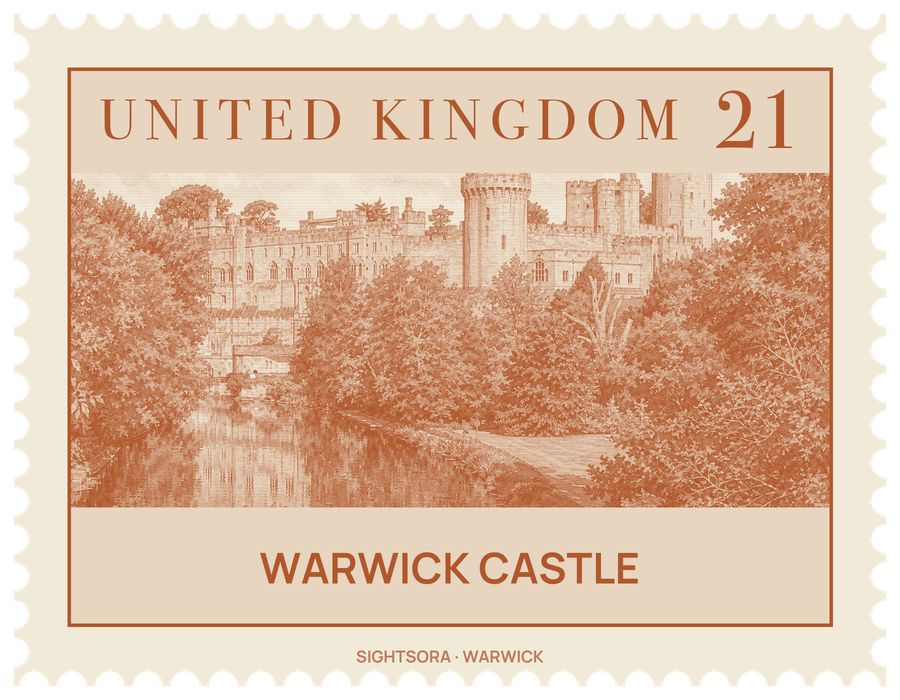
William the Conqueror put up a wooden motte-and-bailey castle here in 1068 to hold the Midlands, and in the 12th century, under Henry II, it was rebuilt in stone, with its buildings set against a curtain wall. The mound of the first castle still stands in the south-west corner of the site.
The face most visitors know comes from the 14th century. In 1330–60 Thomas de Beauchamp, 11th Earl of Warwick, strengthened the north-east side with a gatehouse and barbican and two towers, Caesar's Tower and Guy's Tower, both vaulted in stone on every floor and crowned with machicolations; Caesar's Tower has a double parapet and a dungeon in its basement. The gatehouse kept murder holes, portcullises and two drawbridges. The riverside front, by contrast, was built mainly to show off the wealth of the Beauchamp earls. In the 1480s Richard III started the Bear and Clarence Towers, built for guns, which flank the gateway in the north-west wall but were left unfinished at his death.
Warwick also belonged to Richard Neville, the Kingmaker, who held Edward IV prisoner here in 1469. By the time James I granted the run-down castle to Sir Fulke Greville in 1604, it was turning into a country house; Greville's family, later Earls of Warwick, lived in it until 1978. Greville was murdered in London in 1628, and the Watergate Tower, where he had his rooms, is known as the Ghost Tower. A fire in 1871 gutted the Great Hall and the private apartments, which Anthony Salvin restored over the next few years with money raised from the public. Along the river side runs the residential wing, with the great hall, library, chapel and bedrooms, and after the Tussauds Group bought the castle in 1978, wax figures were placed in twelve of the rooms to recreate a weekend party held in 1898 for the Prince of Wales.
The grounds below the castle were landscaped from 1749 by Capability Brown, who swept the lawns down to the riverbank and framed them with clumps of native trees; Robert Marnock added formal gardens in 1868–69, and Castle Park lies to the south. Canaletto painted the castle in 1747, while Brown was at work, and five of his paintings of it are known. Attractions at the castle include the Falconer's Quest bird of prey display, jousting, the trebuchet below the walls, the Horrible Histories Maze and the Castle Dungeon, an attraction staged by live actors, and visitors can stay overnight in rooms inside Caesar's Tower.
Getting there
Warwick railway station is about 1.6 kilometres from the castle. By road it is less than 3.2 kilometres from junction 15 of the M40 motorway, and Birmingham Airport is relatively close.