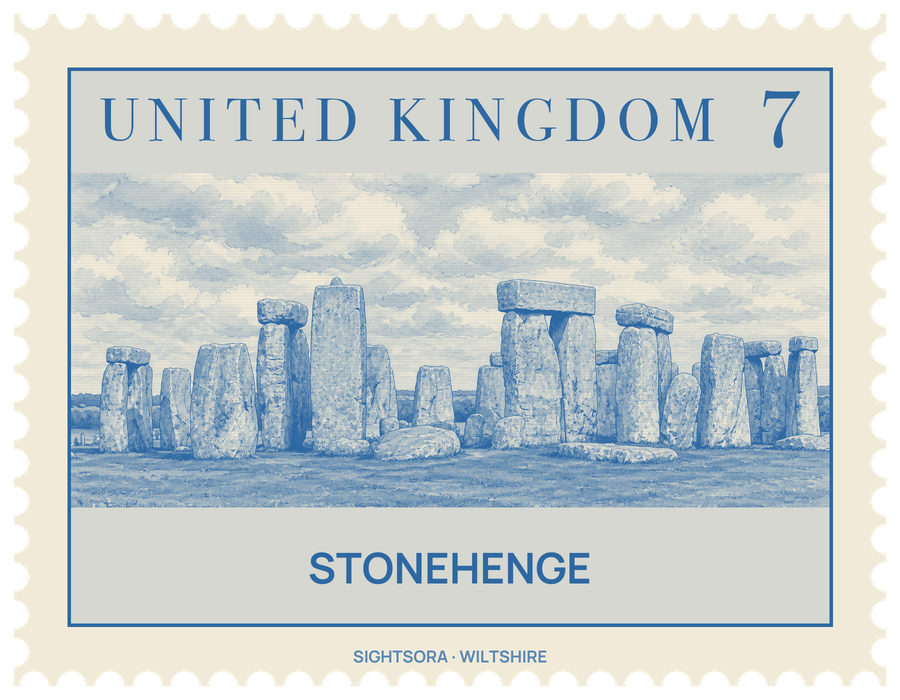
The whole monument is aligned on the midsummer sunrise and the midwinter sunset. It stands at the centre of a dense landscape of Neolithic and Bronze Age monuments, including several hundred burial mounds, and together with that landscape it was added to the UNESCO World Heritage list in 1986. English Heritage manages the stones, and the National Trust owns the land around them.
It was built in stages over some fifteen hundred years. The first monument, around 3100 BC, was a circular ditch and bank, and from about 3000 BC people were burying cremated remains there, so the site seems to have been linked with the dead from the start. The bluestones, some of them dolerite, were brought from the Preseli Hills in Wales, about 150 miles away, and quarries used for them have been found there. The big sarsen circle went up between 2600 and 2400 BC, using stone from West Woods near Marlborough, to the north. The last known construction work dates from about 1600 BC.
The builders shaped the sarsens with techniques borrowed from carpentry: the uprights carry the lintels on mortise and tenon joints, and the lintels lock to each other with tongue and groove joints. The uprights widen slightly towards the top so they look straight from the ground, and the lintels curve to follow the line of the circle. Inside, five trilithons form a horseshoe that opens to the north-east, rising towards the tallest in the south-west, of which a single upright still stands. Outside the north-eastern entrance stands the Heel Stone, and the Avenue, a pair of parallel banks and ditches, runs for two miles from there to the River Avon.
Visits begin at the visitor centre about 1.5 miles west of the stones, which opened in December 2013 after the old A344 road beside the monument was closed and grassed over. The exhibition there brings visitors face to face with a reconstruction of a man who lived 5,500 years ago, and outside, recreated Neolithic houses show how the builders lived, along with a chance to try moving a sarsen stone.
Woodhenge, another prehistoric site, lies a few miles away.