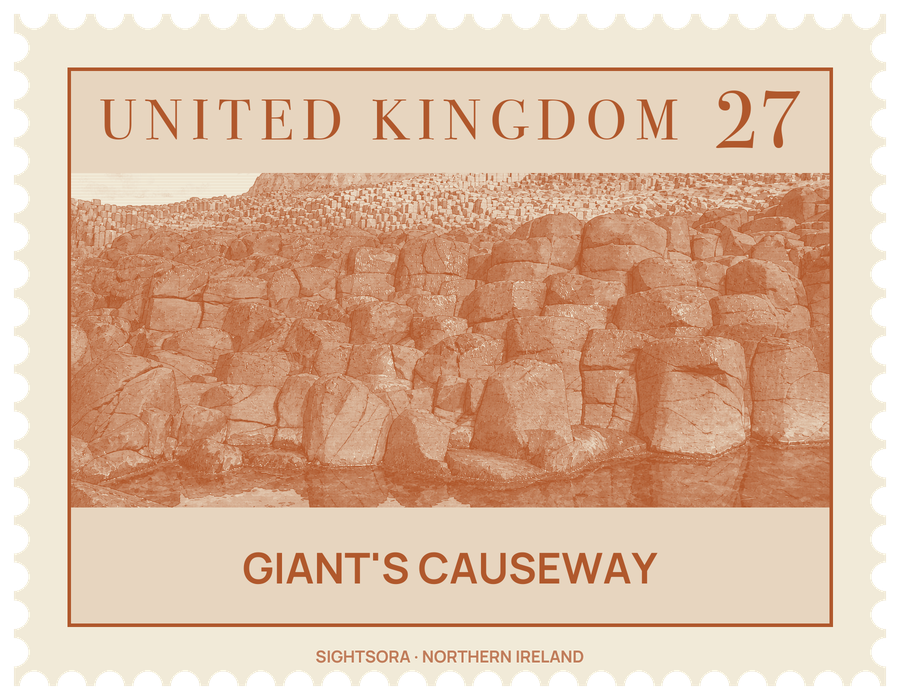
Most are six-sided, though some have between four and eight sides, and their flat tops form stepping stones that run from the foot of the cliffs down into the sea; the tallest columns stand about 12 metres high. The site lies roughly five kilometres north-east of the village of Bushmills and was declared a UNESCO World Heritage Site in 1986.
The columns were formed by volcanic activity some 50 to 60 million years ago, when very fluid basalt lava spread across chalk beds and built up a broad plateau. As the lava cooled it shrank and cracked, much as mud does when it dries, and the cracks worked downward to leave pillars that also split across into segments, often with a convex face sitting in a hollow one, like a ball and socket. Across the sea, the same ancient lava flow produced similar columns at Fingal's Cave on the Scottish island of Staffa.
Local legend gives a different answer. The Irish giant Fionn mac Cumhaill was challenged by the Scottish giant Benandonner, so he laid a causeway over the sea to Scotland, across the North Channel, for the fight. In one popular version, Fionn's wife Sadhbh disguised him as a baby when he saw how big his rival was; Benandonner, imagining the size of a father with such an infant, fled home to Scotland and tore up the causeway behind him.
Weathering has shaped some formations into recognisable objects, and walkers along the shore look for the Organ and the Giant's Boot. Other named features are the Honeycomb, the Camel's Hump, the Giant's Gate, the Chimney Stacks, the Giant's Harp and the Shepherd's Steps. The cliffs are a haven for seabirds such as fulmars, cormorants, guillemots and razorbills, and plants like sea spleenwort and frog orchid grow on the rocks. The National Trust owns and looks after much of the site and runs the visitor centre.
The causeway came to wider notice after William King, Bishop of Derry, visited in 1692 and a paper on it was presented to the Royal Society the following year. Watercolours painted by the Dublin artist Susanna Drury in 1739 spread its fame further, and in a caption to plates engraved from them for the French Encyclopédie, the geologist Nicolas Desmarest was the first to propose in print that such columns were volcanic. Tourism grew in the 19th century, especially once the Giant's Causeway Tramway opened.
Getting there
Northern Ireland Railways trains on the Belfast-Derry line run to Coleraine, with a branch line on to Portrush, and local Ulsterbus services link up with the stations. Walkers can also set out from Portrush on a coastal route of about 11 kilometres, passing Dunluce Castle and following the heritage Giant's Causeway and Bushmills Railway.