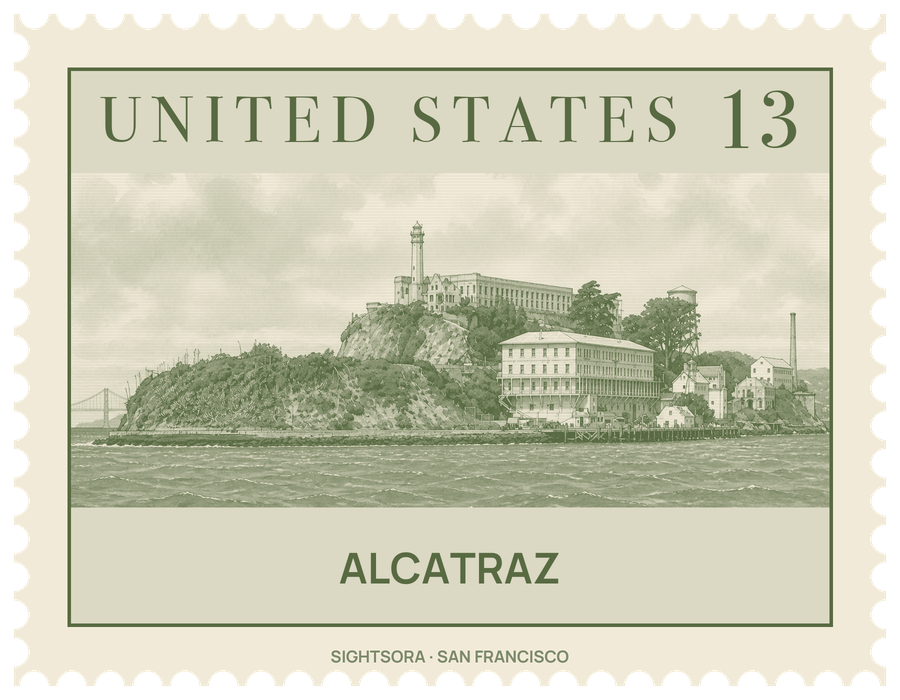
Cold water and strong tidal currents around the rock made escape close to impossible, and that isolation shaped every use the island has had. Since 1972 the island has belonged to the Golden Gate National Recreation Area and has been run by the National Park Service as a historic site and a museum of its prison years, and in 1986 it became a National Historic Landmark.
The island's name goes back to the Spanish explorer Juan Manuel de Ayala, who charted the bay in 1775 and called an island there after the alcatraz, an old Spanish word for pelican; an English captain, Frederick W. Beechey, later moved the name to this rock. From 1853 the army fortified it, and by the Civil War it carried more than a hundred cannons around its edge, though they never fired on an enemy. The army soon found the island more useful as a jail: in 1868 it was officially made a long-term military prison, and the huge concrete cell block that is still the island's dominant feature was built between 1909 and 1912, on top of the lower floor of an older barracks, which is where the legend of "dungeons" beneath the cells comes from.
As a federal prison, Alcatraz was meant for inmates who kept causing trouble elsewhere, and in its 29 years it held Al Capone, George "Machine Gun" Kelly and Robert Stroud, the "Birdman of Alcatraz". Thirty-six prisoners made fourteen attempts to escape. The most famous came on the night of June 11, 1962, when Frank Morris and the brothers John and Clarence Anglin left papier-mâché dummy heads in their beds, climbed out through a widened vent and the roof, and launched a raft made from prison raincoats; they were never seen again. Guards and their families also lived on the island, and their children went to school there.
The buildings most visitors come for are the Main Cellhouse, the Dining Hall and the Recreation Yard. Elsewhere on the island stand the Lighthouse, the Water Tower, Building 64 and the New Industries Building, along with what is left of the Social Hall and the Warden's House, and the flattened Parade Grounds at the southern tip. From November 20, 1969, Native American activists occupied the island for nineteen months to protest federal policy, and graffiti from that occupation can still be seen in many places.
The island is also a place for wildlife. Its western cliffs, close to a hundred feet high, are used by nesting cormorants, pigeon guillemots and western gulls, and harbor seals sometimes haul out on a small beach below them. Black-crowned night herons breed on the rubble-covered parade grounds, the tide pools were left by old quarrying, and gardens first planted by army and prison families grow roses, succulents and geraniums among apple and fig trees.
Getting there
Visitors cross to the island by ferry. Boats leave from Pier 33 on the San Francisco waterfront, which lies between the Ferry Building and Fisherman's Wharf.