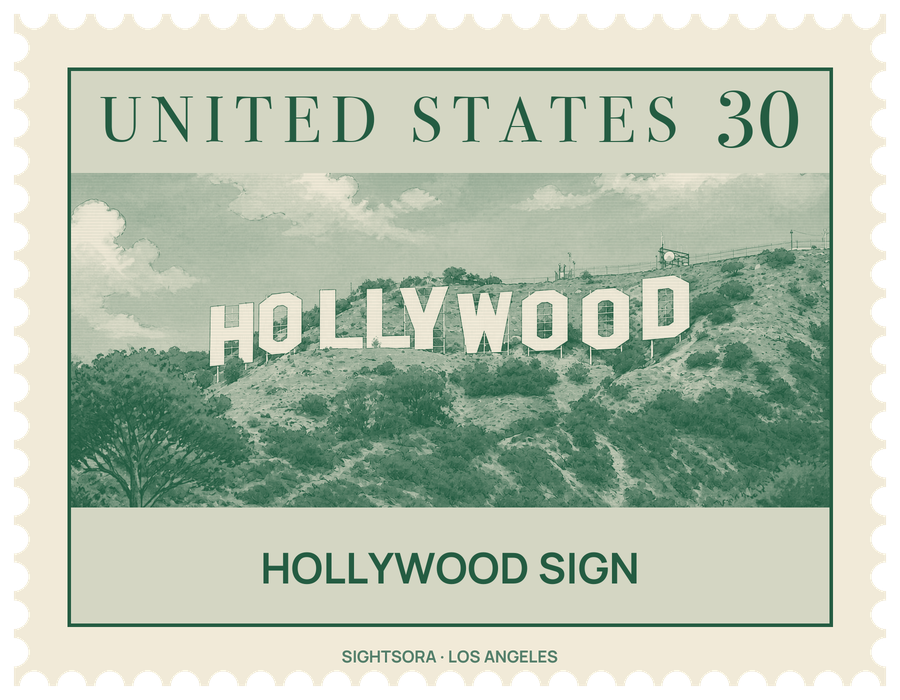
It was put up in 1923 as a short-term advert for Hollywoodland, a new housing development: thirteen wooden letters, each 50 feet high and 30 feet wide, lit by around 4,000 bulbs that flashed "HOLLY", "WOOD" and "LAND" in turn. It was dedicated on 13 July 1923 and expected to last a year and a half, but as Hollywood's film industry grew it became a symbol of the place and was never taken down.
Neglect took its toll. The lights went dark around 1933, the H was destroyed in early 1944, and in 1949 the Hollywood Chamber of Commerce agreed with the city to repair the sign on condition that the last four letters be removed, so that it named the district rather than the housing estate. By 1978 the wood-and-sheet-metal letters were falling apart, with one O broken and another collapsed. Nine donors each paid for one new letter, and the present sign, built of steel on concrete foundations with letters more than 40 feet tall, was unveiled on November 11, 1978. The Hollywood Sign Trust, set up that year, paints and maintains it, and the land itself belongs to the City of Los Angeles.
The building and tower just behind the sign belong to the city's Central Communications Facility, which carries radio links for the police, the fire department and other agencies. From 1939 to 1947 the site held the studios and transmitter of W6XAO, the first television station in Los Angeles, founded by the Don Lee Network, which gave Mount Lee its name. Cahuenga Peak, the ridge to the left of and above the sign, was bought in 2010 after a public fundraising campaign that briefly covered the letters with "SAVE THE PEAK" banners, and it is now part of Griffith Park.
The letters themselves cannot be reached. They stand on rough, steep ground behind barriers, and a security system with motion detectors and cameras, monitored by the Los Angeles Police Department, raises an alarm when anyone enters the restricted area. Griffith Park is also classed as a high fire risk area because of its dry brush. The Hollywood Sign Trust points visitors to two official viewing spots: the Hollywood and Highland Center and Griffith Observatory; from the observatory, the walk towards the sign can take up to two hours each way.
The residential streets of Beachwood Canyon and Lake Hollywood Estates below the sign were not built for crowds and lack parking, restrooms and drinking water, and much of northern Beachwood Canyon has parking reserved for residents. The closest viewpoint to the sign is a spot known as The Last House on Mulholland.