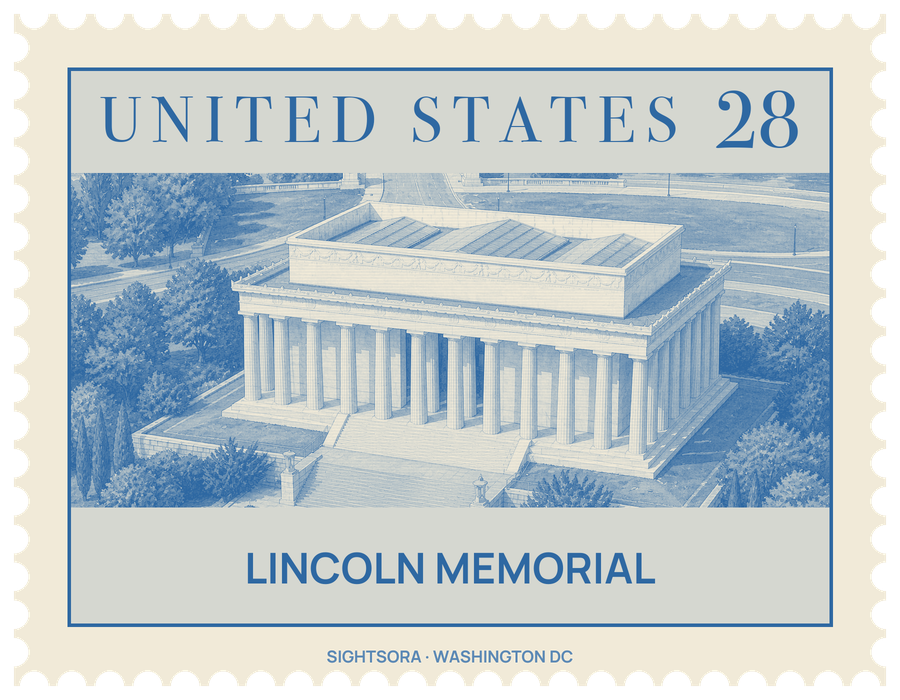
The memorial was designed by the architect Henry Bacon in the form of a Greek temple, the statue by Daniel Chester French, and it was dedicated on May 30, 1922, in the presence of Lincoln's last surviving son, Robert Todd Lincoln. It is run by the National Park Service together with the neighbouring war memorials on the Mall.
Thirty-six fluted Doric columns surround the building, one for each state in the Union when Lincoln died, and the names of those states run along the frieze above them; higher still, on the attic, are the names of the 48 states of 1922. The columns and walls lean slightly inwards, an old Greek device that keeps the building from seeming to swell at the top. The exterior is of Yule marble from Colorado. From the edge of the Reflecting Pool, 87 steps climb to the chamber, a number chosen to echo "four score and seven years" from the Gettysburg Address.
Inside, two rows of Ionic columns divide the memorial into three chambers. The statue fills the central one: carved from Georgia white marble by the six Piccirilli brothers over four years and shipped in 28 pieces, it was enlarged from a planned 10 feet so that it would not be dwarfed by the hall, and a standing Lincoln at this scale would be 28 feet tall. His arms rest on carved Roman fasces, and above his head is an epitaph by Royal Cortissoz. The side chambers carry Lincoln's Gettysburg Address and his second inaugural address cut into the walls, each crowned by a mural by Jules Guérin showing principles from his life, such as Freedom, Justice, Unity and Charity. Light filters through ceiling panels of Alabama marble soaked in paraffin to make them translucent.
The memorial has also become a stage for the struggle over civil rights. When Marian Anderson was barred from singing to an integrated audience at Constitution Hall in 1939, she performed on these steps on Easter of that year instead, before a crowd of 75,000. On August 28, 1963, the great March on Washington, demanding jobs and freedom, ended here, and Martin Luther King Jr. delivered his "I Have a Dream" speech in front of the memorial to the president who had issued the Emancipation Proclamation a hundred years before. In 2003 an inscription was cut into the landing where King stood, eighteen steps down from the statue. The 1922 dedication itself had seated prominent African American guests in a segregated section.
Beneath the building lies a vast undercroft, where workers scrawled what the Park Service calls "historic graffiti" during construction and water seeping through the marble has formed stalactites and stalagmites. A museum with a theater and exhibits opened in part of this space in June 2026.