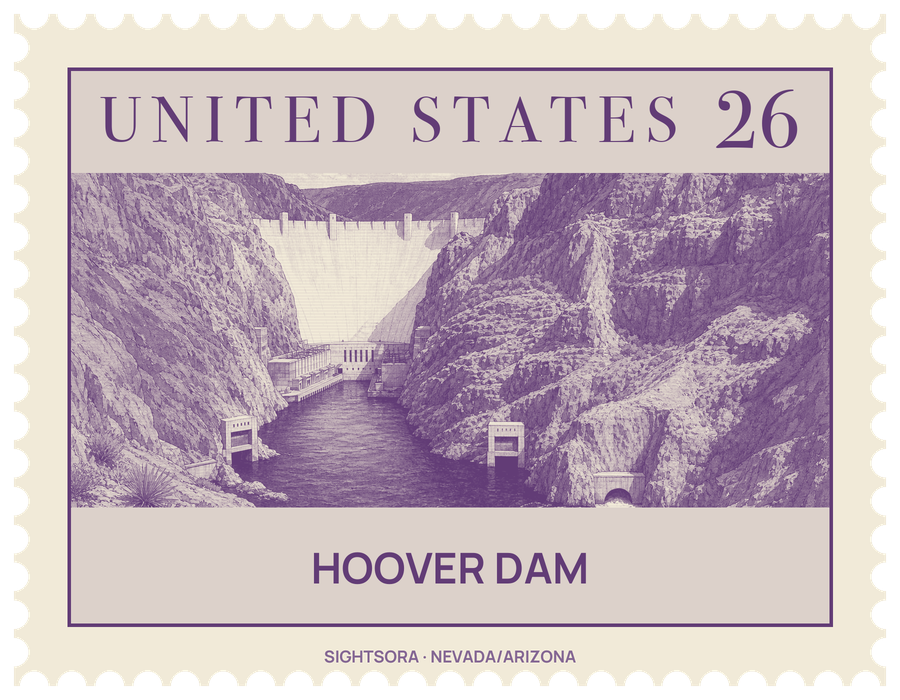
It stands near Boulder City, a town first built to house the construction workers; Las Vegas is some 30 mi (48 km) to the northwest. The dam was built between 1931 and 1936, in the depths of the Great Depression, and President Franklin D. Roosevelt dedicated it on September 30, 1935. It was meant to tame the river's floods, store water for irrigation and generate hydroelectric power, and its generators still supply utilities in Nevada, Arizona and California.
The dam is an arch-gravity design: thick at the bottom and thin at the top, it curves outward against the lake so that the water's push is carried into the canyon walls. It measures 660 ft (200 m) through at the base and just 45 ft (14 m) along the crest, wide enough for a road between the two states. The concrete was poured as separate interlocking columns, cooled by river water and chilled water pumped through more than 582 miles of embedded pipe, because engineers calculated that a single solid pour would take 125 years to cool and would crack. A consortium called Six Companies, led on site by the superintendent Frank Crowe, beat its deadline by over two years, and the government formally took over the dam on March 1, 1936.
The work came at a heavy human cost. Before the dam could rise, four diversion tunnels were bored through the canyon walls to carry the river around the site, and "high scalers" hanging from ropes cleared loose rock from the cliffs with jackhammers and dynamite; the tar-dipped cloth hats some of them wore led to the first hard hats. In the summer of 1931 daytime highs averaged 119.9 °F, and sixteen workers and riverbank residents died of heat in a single month. Of the 112 deaths officially linked to the project, 96 happened during construction at the site, and the figure leaves out dozens of workers recorded as dying of pneumonia. Contrary to a persistent story, no one is buried in the concrete.
Much of what visitors see is the work of the Los Angeles architect Gordon B. Kaufmann, who replaced a plain first design with streamlined Art Deco: turrets rising from the face of the dam and clocks on the intake towers, one showing Nevada time and the other Arizona time. On the Nevada side, the dedication plaza by the sculptor Oskar J. W. Hansen has two 30-foot bronze Winged Figures of the Republic flanking a flagpole, set on a terrazzo floor with a star map showing the sky at the moment of Roosevelt's dedication. Hansen also made a plaque honouring the workers who died and the reliefs on the elevator towers, while the Denver artist Allen Tupper True decorated floors and walls inside with motifs drawn from Navajo and Pueblo art.
Below the dam, the U-shaped powerhouse sits at its downstream foot, fed by water that falls through the intake towers and narrowing penstocks. Two spillways behind the abutments guard against the lake overtopping the dam; their great tunnels have been used only twice, in a test in 1941 and during the 1983 flood. The name itself has a history: Congress had used the name of President Herbert Hoover in its bills, but Roosevelt's officials insisted on Boulder Dam instead, and only in 1947 was the name Hoover Dam restored.
Tours of the dam are run by the Bureau of Reclamation, with a choice between a guided tour of the whole facility and one of the power plant area only. Security rules keep visitors out of most of the interior, so few of True's decorations can be seen. The visitor center can be explored without a guide and has exhibits and a 360-degree view over the dam. Visitors can drive across the crest, and since 2010 through traffic has used the Hoover Dam Bypass, which crosses the canyon 1,500 ft (460 m) downstream on an arch bridge named after Mike O'Callaghan and Pat Tillman.
Getting there
Las Vegas is roughly 30 mi (48 km) away by road, and Boulder City is the nearest town. Visitors use the old road over the dam, approaching from the Nevada side and crossing to the parking lots and facilities on the Arizona side; through traffic on US 93 takes the Hoover Dam Bypass instead.