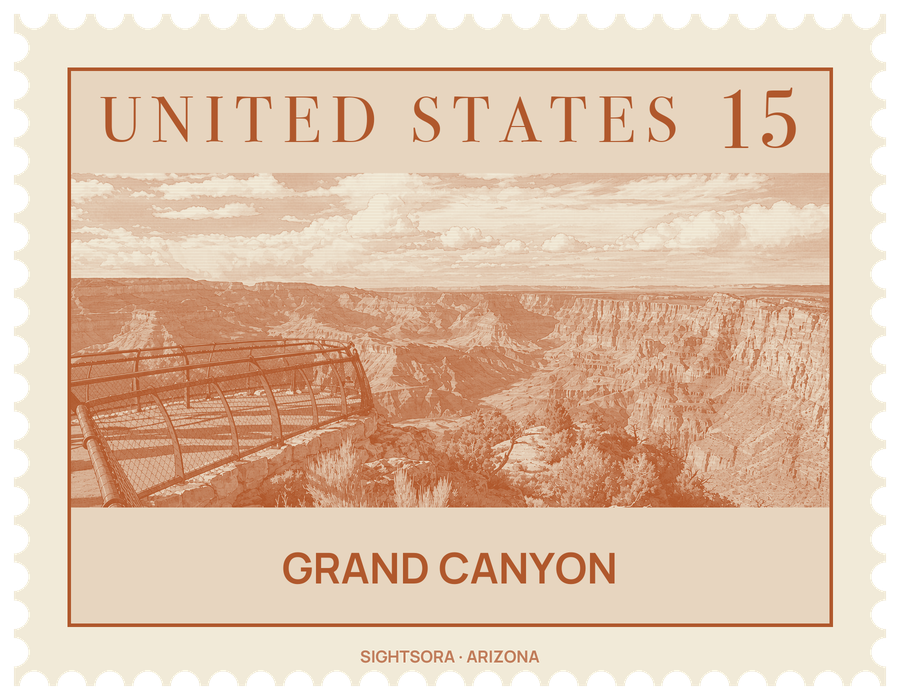
The national park that protects it covers 1,217,262 acres in Coconino and Mohave counties. Theodore Roosevelt, who visited in 1903, made it a national monument in 1908, and President Woodrow Wilson signed the act creating the national park on February 26, 1919. UNESCO added it to the World Heritage list in 1979.
Visitors mostly see the canyon from one of its two rims, which face each other across the gorge. The South Rim is easier to reach and takes 90% of the park's visits; its centre is Grand Canyon Village, near the South Entrance, with lodging, food, fuel, a hospital and the starting points of trails and guided walks. Mather Point, usually the first view people reach after driving in from the south, is a common place to start. The North Rim, on the Kaibab Plateau, sits higher, at over 8,000 feet; its main visitor area is around Bright Angel Point, and roads lead out to viewpoints such as Point Imperial, Roosevelt Point and Cape Royal.
On the South Rim, a scenic drive of about 35 miles is split in two. The western part runs eight miles to Hermit's Rest, past overlooks that include Hopi Point, Mohave Point and the Powell Memorial, and for part of the year it can only be reached on a Park Service shuttle. The eastern part runs 25 miles to Desert View and is open to private vehicles all year. On foot, the Rim Trail follows the edge westward from the Pipe Creek viewpoint, paved for roughly the first eight miles, and since the shuttle can bring walkers back, a hike can start almost anywhere along it.
Grand Canyon Village keeps a group of early 20th-century buildings. El Tovar, a railway hotel of 1905 built for the Atchison, Topeka and Santa Fe line, recalls a Swiss chalet or a Norwegian villa built from local materials. The architect Mary Colter designed several others: Hopi House of 1905, modelled on the old Hopi settlement of Old Oraibi; Lookout Studio of 1914, with a view of the Bright Angel Trail; Hermit's Rest; and Bright Angel Lodge of 1935, where a stone fireplace in the History Room is laid in the same order as the rock layers of the canyon. The log-built Grand Canyon Railway Depot of 1910 is the end of the line for trains from Williams.
Trails also lead below the rim. From the north, the North Kaibab Trail drops all the way to the Colorado River, where it links across the water to the South Kaibab and Bright Angel trails climbing to the South Rim; Phantom Ranch offers lodging on the canyon floor. On the North Rim, mule rides go to various points, some of them several thousand feet down into the canyon.
Getting there
Most visitors reach the South Rim on Arizona State Route 64, which enters the park at the South Entrance near Tusayan and leaves by the East Entrance; Interstate 40 gives access from the south, and Route 89 links the North Rim, Utah and Colorado with the South Rim. The Grand Canyon Railway runs from Williams, Arizona, to a depot in Grand Canyon Village. Driving from one rim to the other takes about 4.5 hours, a distance of over 220 miles.