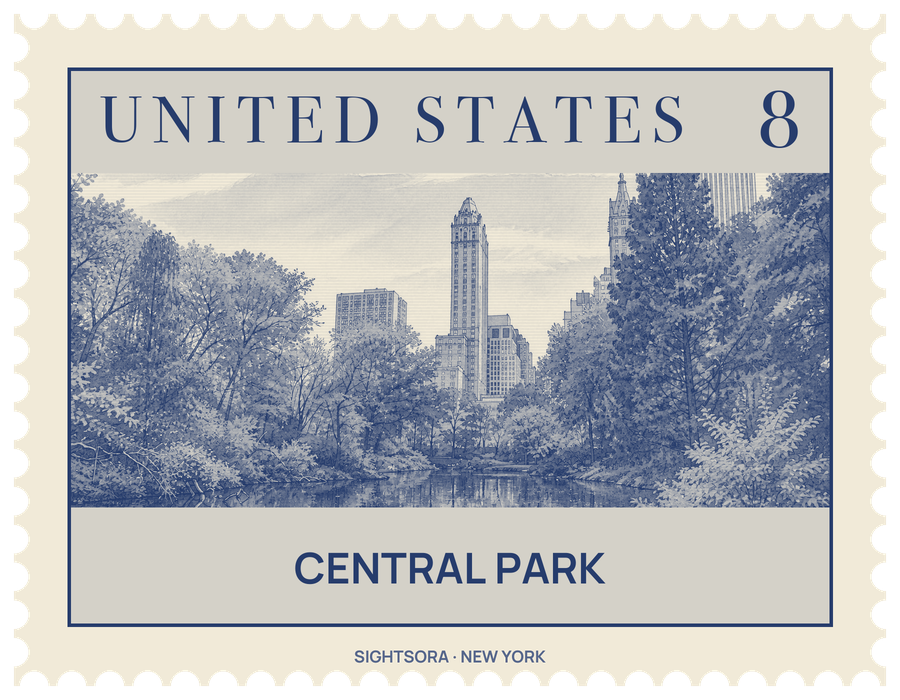
Although it looks natural, almost all of it was shaped by hand in the 1850s and 1860s: its eight lakes and ponds were made by damming seeps and streams, and its woods, meadows and rocky outcrops were arranged for effect. A design competition in 1858 went to Frederick Law Olmsted and Calvert Vaux with their "Greensward Plan", the first areas opened late that year, and the park was finished in 1876. Making room for it meant clearing existing homes, among them Seneca Village, a settlement whose residents were mostly Black.
The south end, below the Lake, holds many of the earliest Victorian Gothic structures. Bethesda Terrace, a two-level hall facing the Lake, frames a fountain crowned by Emma Stebbins's Angel of the Waters of 1873, the one statue that was part of the original design. It connects to the Mall, a landscaped promenade, and beside it Literary Walk is set with busts of authors and poets. Near the western shore are Sheep Meadow, a lawn first meant as a parade ground, and Strawberry Fields, the memorial to John Lennon with its "Imagine" mosaic given by Italy, close to the Dakota building where he was killed. Along the southern edge lie the carousel, playgrounds, the Central Park Zoo and Wollman Rink.
The Lake, crossed at its centre by Bow Bridge, opened to skaters in December 1858; the Loeb Boathouse on its eastern shore hires out rowing boats. Just to the east, model boats are sailed on Conservatory Water, where a sculpture of Alice in Wonderland stands. Beside the Lake lies the Ramble, about 36 acres of winding paths where at least 250 bird species have been recorded. Farther north, Belvedere Castle and the Delacorte Theater, home of the Shakespeare in the Park productions, stand on the western shore of Turtle Pond, at the foot of the Great Lawn. West of the Metropolitan Museum of Art rises Cleopatra's Needle, a red granite obelisk first raised at Heliopolis around 1450 BC which arrived in New York in late 1880.
Above 86th Street, the Jacqueline Kennedy Onassis Reservoir spreads across 106 acres up to 96th Street, built between 1858 and 1862 and no longer used for water supply. The northern third was planned as the park's "natural section": the North Woods, with a stream called the Loch running through a wooded ravine, the Conservatory Garden, the only formal garden, reached by the Vanderbilt Gate on Fifth Avenue at 105th Street, and Harlem Meer in the northeast corner, where catch-and-release fishing is allowed. Near McGowan's Pass stands Blockhouse No. 1, a fort from the War of 1812 that predates the park.
The park's 6.1 miles of drives are given over to runners, cyclists and skaters, and the New York City Marathon finishes outside Tavern on the Green. Rock outcrops left by glaciers, such as Rat Rock at the southwest corner, draw boulderers. Summer brings performances, among them the SummerStage series, an open-air concert by the New York Philharmonic on the Great Lawn and an August film festival. Visitor centres are found at Belvedere Castle, the Dairy, the Chess & Checkers House, Columbus Circle and the Dana Discovery Center on Harlem Meer.
Getting there
The A, B, C and D subway trains run beneath Central Park West along the western edge; the B and C stop at the local stations along it, and all four, plus the 1, stop at 59th Street – Columbus Circle at the southwest corner. At the southeast corner, N, R and W trains stop at Fifth Avenue and 59th Street, and in the north the 2 and 3 stop at Malcolm X Plaza. The M10 bus runs along Central Park West, the M1 to M4 come south down Fifth Avenue, and crosstown buses including the M66, M72, M79, M86 and M96 use the transverse roads through the park.