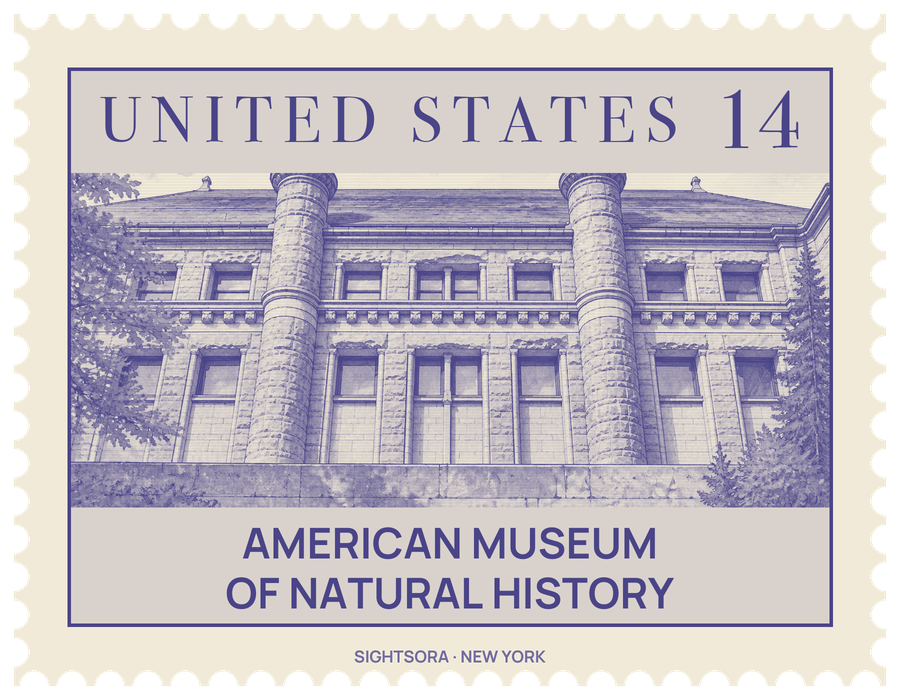
The naturalist Albert S. Bickmore came up with the idea in 1861; the museum first opened in Central Park's Arsenal in 1871 and moved into its first building on the present site, the work of Calvert Vaux and J. Wrey Mould, in 1877. Its collections run to about 32 million specimens, from fossils and meteorites to human cultural objects, and only a small share of them can be shown at once.
The main entrance on Central Park West is New York State's memorial hall to Theodore Roosevelt, a Beaux-Arts hall by John Russell Pope completed in 1936. A 60-foot arch in a pink-granite front leads into a barrel-vaulted hall 100 feet high, with red-marble columns and murals by William Andrew MacKay of episodes from Roosevelt's life, among them the Panama Canal. Beyond it lies the Akeley Hall of African Mammals, named after the taxidermist Carl Akeley, where 28 dioramas show African landscapes and their animals around a central herd of eight elephants in an alarmed stance. Painted habitat scenes in the same tradition fill the Hall of Asian Mammals and, for animals of North America, the Bernard Family Hall.
The whole fourth floor is given over to fossils. A marked route leads from the Wallach Orientation Center along a tree of life, through the halls of saurischian and ornithischian dinosaurs and the Hall of Vertebrate Origins. The Tyrannosaurus rex stands in a horizontal stalking pose and is built almost entirely from real bones of two skeletons that Barnum Brown dug up in Montana in 1902 and 1908; nearby are a Triceratops, a Stegosaurus, an Allosaurus mounted over a Brontosaurus carcass, and an Edmontosaurus fossil with impressions of its skin, lying on its side as it was found.
On the first floor, the Milstein Hall of Ocean Life is built around a blue whale model 94 feet long, hung above dioramas of kelp forests, mangroves and coral reefs, including the "Squid and the Whale" scene. The Arthur Ross Hall of Meteorites shows Ahnighito, a 34-ton piece of the Cape York meteorite from Greenland, held up by columns that run down into the bedrock. Just north of it, the Mignone Halls of Gems and Minerals display pieces such as the Star of India and the Patricia Emerald, and the Spitzer Hall of Human Origins has a cast of the Lucy skeleton. The Northwest Coast Hall, founded by Franz Boas in 1899, holds carved house posts of the Kwakwaka'wakw and a Haida canoe hanging from the ceiling.
On the north side, the Rose Center for Earth and Space, completed in 2000 to a design by James Stewart Polshek, is a glass cube six stories high with an illuminated sphere 87 feet across inside it; the sphere holds the Space Theater of the Hayden Planetarium. On the Columbus Avenue side, the Richard Gilder Center by Studio Gang opened in May 2023 with a canyon-like atrium of sprayed concrete, an insectarium, a butterfly vivarium where visitors walk among live butterflies, and an immersive film called "Invisible Worlds".
Getting there
The museum is at Central Park West and 79th Street. The subway station at 81st Street (Museum of Natural History), served by the B and C trains, has an entrance straight into the building, right underneath the Roosevelt Memorial Hall; the Gilder Center adds a second entrance on Columbus Avenue.