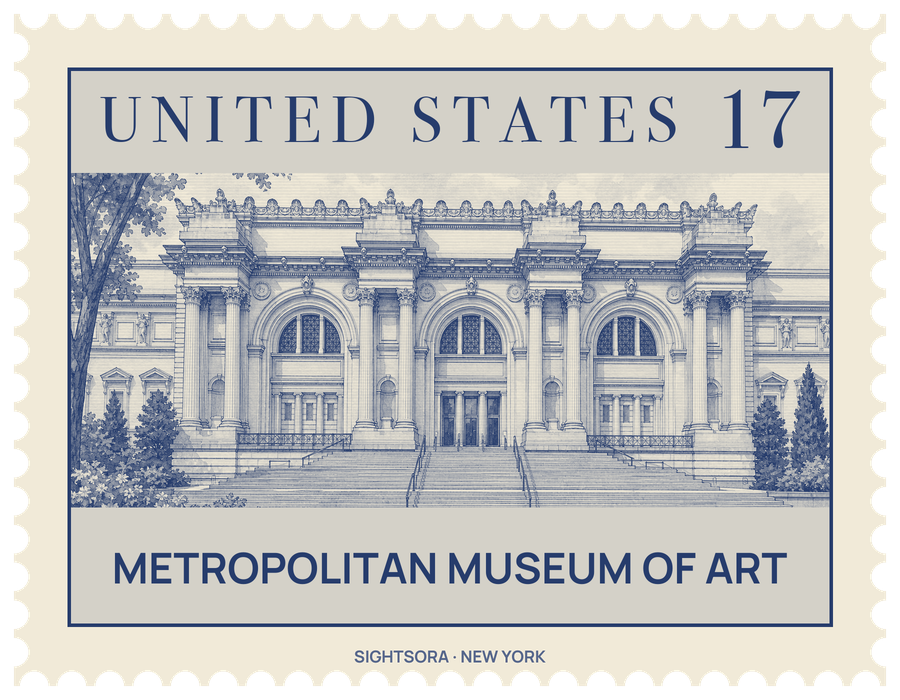
It was founded in 1870 by a group of businessmen, financiers and artists who wanted a museum that would teach and inspire the public, and it moved to the park in 1880 into a red-brick and stone building by Calvert Vaux and Jacob Wrey Mould. The grand Fifth Avenue front, the Great Hall and the Grand Stairway are Beaux-Arts work by Richard Morris Hunt and his son, while the glass sides and back of the building were added by Roche-Dinkeloo. Behind them, more than 20 structures have grown together, most of them invisible from outside.
The collection reaches from the ancient Near East and Egypt to contemporary art, split among 17 curatorial departments. Its best-known single object is the Temple of Dendur, a sandstone temple taken down by Egypt to save it from the waters of the Aswan High Dam, presented to the United States in 1965 and rebuilt in its own gallery in 1978, beside a reflecting pool and a wall of windows facing Central Park. The Egyptian wing has 40 galleries, with the wooden models of daily life found at Thebes in 1920 and the small faience hippopotamus nicknamed William, the museum's informal mascot. Assyrian lamassu, human-headed guardian figures from the palace of Ashurnasirpal II, stand in the Near Eastern galleries.
Upstairs, the European paintings run from the 13th to the early 20th century, among them Bruegel's The Harvesters, Vermeer's Woman with a Lute, Rembrandt's Aristotle Contemplating the Bust of Homer and Caravaggio's The Musicians. The 19th-century French rooms are rich in Courbet, Degas, Manet, Monet, Cézanne and Van Gogh, much of it from the Havemeyer and Annenberg gifts. The American Wing traces American art from the 18th to the early 20th century, and other well-known canvases in the museum include Sargent's Madame X, Winslow Homer's The Gulf Stream and Thomas Cole's The Oxbow. The modern galleries hold Picasso's portrait of Gertrude Stein and Jackson Pollock's Autumn Rhythm (Number 30).
Several departments rebuild whole interiors. The Greek and Roman galleries include a bedroom from a villa at Boscoreale buried by Vesuvius in 79 CE and the Etruscan Monteleone chariot; European decorative arts include the 16th-century patio of Vélez Blanco castle in Spain, set up in a two-storey gallery; the Islamic galleries contain the Nur Al-Din Room from a house in Damascus; and the Asian wing has the Astor Court, a Ming-style garden court modelled on a courtyard of Suzhou's Master of the Nets Garden. On the first floor, a parade of armoured knights on horseback leads into the Arms and Armor galleries, where armour that belonged to Henry VIII is shown. The musical instruments collection has Stradivari violins and a 1720 piano by Bartolomeo Cristofori, and each year the high arched medieval hall is where the museum puts up its decorated Christmas tree.
The Robert Lehman Wing keeps a private collection together as a museum within the museum, strong in Sienese painting and including Botticelli's Annunciation. The Costume Institute stages fashion exhibitions from its stock of more than 35,000 costumes and accessories and hosts the annual Met Gala. Up top, the Cantor Roof Garden sits near the southwest corner of the building. A second, much smaller branch, The Cloisters in Fort Tryon Park in Upper Manhattan, is devoted to medieval Europe; it is built around parts of five French cloisters and shows the seven Unicorn Tapestries and the Belles Heures illuminated by the Limbourg brothers.