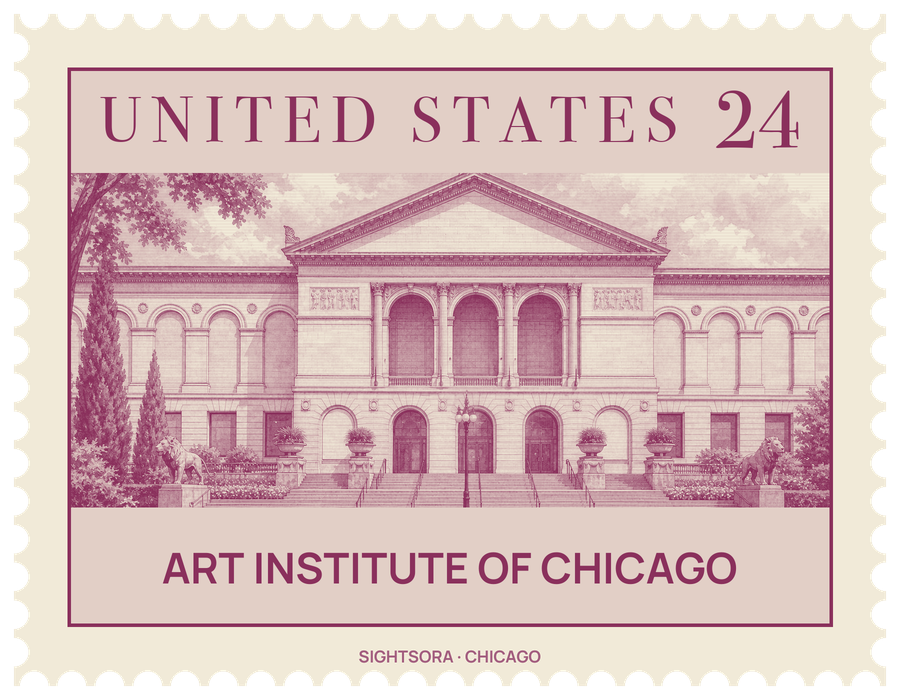
Among the paintings inside are Nighthawks by Edward Hopper, American Gothic by Grant Wood, The Old Guitarist by Pablo Picasso and Georges Seurat's view of La Grande Jatte, part of a collection of around 300,000 works looked after by 11 curatorial departments and spanning more than 5,000 years. The lions have their own local custom: when a Chicago team reaches a league final they are often dressed in its uniform, and at Christmas they wear evergreen wreaths.
The institution grew out of the Chicago Academy of Design, set up by 35 artists in 1866, which lost its building in the Great Chicago Fire of 1871 and went bankrupt in 1879; its successor took the name Art Institute of Chicago in 1882. The present Beaux-Arts building at 111 South Michigan Avenue was designed by Shepley, Rutan and Coolidge for meetings during the 1893 World's Columbian Exposition, on the understanding that the Art Institute would move in once the fair closed, which it did that October. The museum has grown many times since, and its art school remains legally one body with the museum.
The museum is best known for its Impressionist and Post-Impressionist paintings, shown on the upper level of the bridge between the east and west buildings. Claude Monet is represented by more than 30 paintings, among them six Haystacks and several Water Lilies, and the galleries also hold Gustave Caillebotte's Paris Street; Rainy Day, Renoir's Two Sisters (On the Terrace), Cézanne's The Basket of Apples, Toulouse-Lautrec's At the Moulin Rouge and Van Gogh's Bedroom in Arles. The core of the collection came from the "Coburn Renoirs", a gift of over a hundred works from Annie Swan Coburn in the 1930s. Seurat's dotted canvas of La Grande Jatte holds a prominent place, and viewers of Ferris Bueller's Day Off, the 1986 film, will know it from the museum scene.
American art is the other great draw. Nighthawks was bought in 1942, and American Gothic entered the collection in 1930 after Wood submitted it to a contest at the Art Institute and won a medal. Elsewhere, the ancient galleries cover Greek, Etruscan, Roman and Egyptian work and include the mummy and mummy case of Paankhenamun; the Asian collection has a gallery arranged for the quiet viewing of Japanese screens; and on the ground floor are the 68 Thorne Miniature Rooms, miniature interiors built in the 1930s, and the Arthur Rubloff Paperweight Collection. Prints and drawings, which include strong holdings of Dürer, Rembrandt, Goya and Whistler, are shown only from time to time because light damages paper.
The Modern Wing, designed by Renzo Piano and opened on May 16, 2009, holds early 20th-century European art, among it The Old Guitarist, Matisse's Bathers by a River, Magritte's Time Transfixed and Brâncuși's Golden Bird, along with contemporary art from after 1960, photography, and architecture and design galleries with drawings by Frank Lloyd Wright and Mies van der Rohe. The Nichols Bridgeway runs from a sculpture garden on the wing's roof across to Millennium Park. Other details are worth seeking out: the east entrance is framed by the stone arch of Louis Sullivan's Chicago Stock Exchange, rebuilt here with salvaged parts of its trading room after the Exchange was demolished in 1972, and the galleries linking the two halves of the museum pass over open-air railway tracks used by the Metra Electric and South Shore lines.
The collection is large enough that the museum suggests that visitors pick the works they most want to see beforehand, and it runs daily guided tours as well as changing special exhibitions. The Ryerson and Burnham Libraries on the ground floor, strongest in 18th- to 20th-century architecture, are open to the general public.