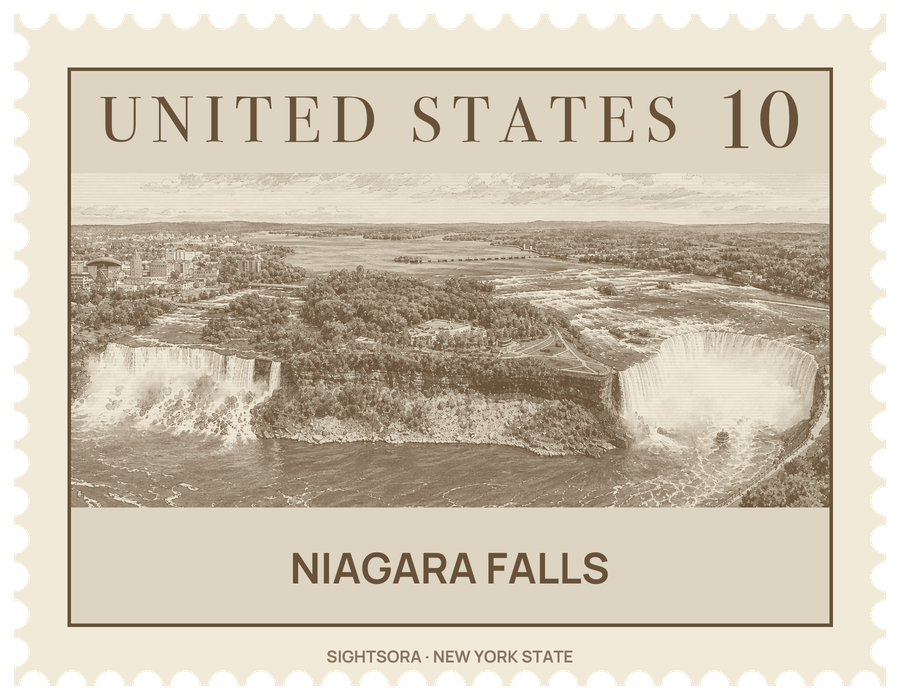
The broad Horseshoe Falls, about 57 metres high and 790 metres wide, lies largely on the Canadian side; the American Falls and the smaller Bridal Veil Falls are within the United States. Goat Island divides the Horseshoe from the other two, and little Luna Island separates the American Falls from Bridal Veil. The falls stand between the twin cities of Niagara Falls, New York, and Niagara Falls, Ontario, 27 kilometres northwest of Buffalo.
The falls took shape after the last ice age, when meltwater from the new Great Lakes poured across the escarpment and began cutting a gorge. A hard cap of limestone and dolomite sits over softer shale; as the river wears away the soft layer, the cap breaks off in blocks, and over thousands of years the falls have moved roughly 10.9 kilometres upstream from their starting point between Queenston and Lewiston. Engineering has since slowed the retreat. The water's green colour comes from dissolved salts and finely ground rock carried by the river. Part of the flow is diverted for hydroelectric power, and less water goes over the falls at night and in winter than on summer days.
By the 1870s public access was limited, visitors often had to pay simply to look at the falls, and industry threatened to carve up Goat Island. A campaign known as Free Niagara, backed by the painter Frederic Edwin Church and the landscape designer Frederick Law Olmsted, led New York to create the Niagara Reservation on April 30, 1885, the state's first state park, and Ontario founded Queen Victoria Niagara Falls Park the same year. Olmsted and Calvert Vaux then planned the American park around scenic roads, paths and a few shelters, aiming to restore the natural setting rather than add to it. In 1969 engineers built a temporary dam that left the American Falls dry for several months while they studied and bolted the rock beneath it.
On the American side, walkways at Prospect Point Park look across the American Falls, and the park also has an observation tower and the dock for the Maid of the Mist, the boat that has taken passengers into the rapids at the foot of the falls since 1846. A bridge above the American Falls carries foot and car traffic to Goat Island, where a lift drops down to the Cave of the Winds and a path beneath Bridal Veil Falls. Goat Island also leads to the Three Sisters Islands and to a statue of Nikola Tesla, whose work on alternating current helped make it possible to harness the falls, and its paths give views of the rapids, the gorge and all three falls. The Niagara Scenic Trolley runs guided trips along the American Falls and around the island, and the Niagara Gorge Discovery Center covers the area's natural and local history.
Across the river in Ontario, Queen Victoria Park has gardens and viewing platforms facing all three falls, and Journey Behind the Falls leads through tunnels to an observation platform near the base of the Horseshoe Falls. The nearby Skylon Tower has an observation deck looking down on the falls, and the Whirlpool Aero Car, a cable car designed by Leonardo Torres Quevedo and built in 1916, crosses over the Niagara Whirlpool. After dusk, floodlights on the Canadian side light up both sides of the falls.
Getting there
Most of the American-side sights lie within Niagara Falls State Park. Two international bridges link the two cities: the Rainbow Bridge, a short way below the falls, open to pedestrians and non-commercial vehicles and giving a close view of the water, and the Whirlpool Rapids Bridge, 1.6 kilometres to the north. Two airports lie close by: Buffalo Niagara International and Niagara Falls International.