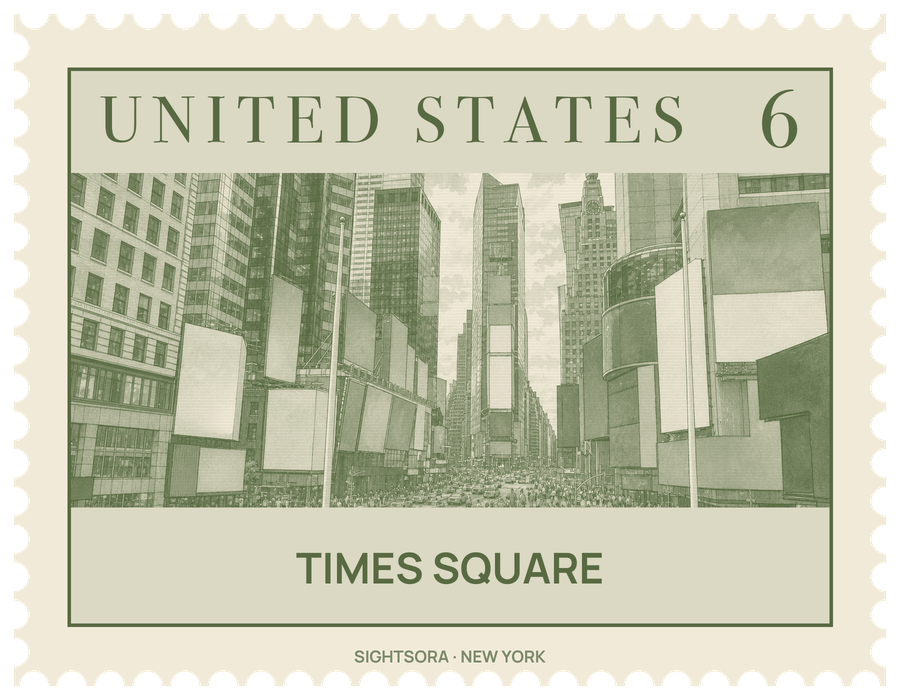
With Duffy Square, its northern half, it runs for five blocks, from 42nd Street up to 47th, at the centre of the Theater District where most Broadway theatres stand. The buildings around it are covered in digital billboards and lit signs, and the area never really goes dark.
In the 19th century this was the hub of the city's horse-carriage trade and was known as Longacre Square, after Long Acre in London. On April 8, 1904, it was renamed Times Square, when The New York Times moved into its new tower on 42nd Street; that building, now One Times Square, carries the ball dropped every New Year's Eve, a tradition that began on December 31, 1907. Theatres, music halls and grand hotels made the square a centre of entertainment after the First World War, but from the Depression onwards it slid into decades of sex shops, peep shows and crime. A clean-up in the 1990s, helped by Disney's restoration of the New Amsterdam Theatre on 42nd Street, brought in new offices, hotels and attractions, though critics complained that the square had been "Disneyfied".
The lights are a matter of law: since 1987 zoning rules have required buildings on the square to carry large illuminated signs, setting a minimum for lighting where other districts set a maximum. The signs are officially called "spectaculars", and among the best known are the curved seven-storey NASDAQ display on 4 Times Square at 43rd Street and the Coca-Cola sign. Since 2009 Broadway between 42nd and 47th Streets has been closed to traffic, and the roadway was rebuilt as a pedestrian plaza of granite paving and benches designed by Snøhetta, completed by the end of 2016.
In Duffy Square stand a statue of Father Francis P. Duffy, a First World War chaplain, by Charles Keck, and a statue of the composer and performer George M. Cohan. Between 45th and 46th Streets, Max Neuhaus installed a permanent sound art piece, itself named Times Square. Times Square Arts, a programme of the Times Square Alliance, works with contemporary artists who use the square's electronic billboards and public plazas for their pieces.
On New Year's Eve about a million people crowd the square and the streets around it to watch the ball descend at midnight, followed by a shower of confetti, and aluminium barriers are set up along the surrounding streets to hold the spectators. An LED ball first appeared for the drop's centenary, and the larger ball that followed it stays in place all year and is also lit for other occasions such as Valentine's Day and Halloween.
Getting there
The square has its own subway station, Times Square – 42nd Street, and another, 42nd Street – Port Authority Bus Terminal, is close by.