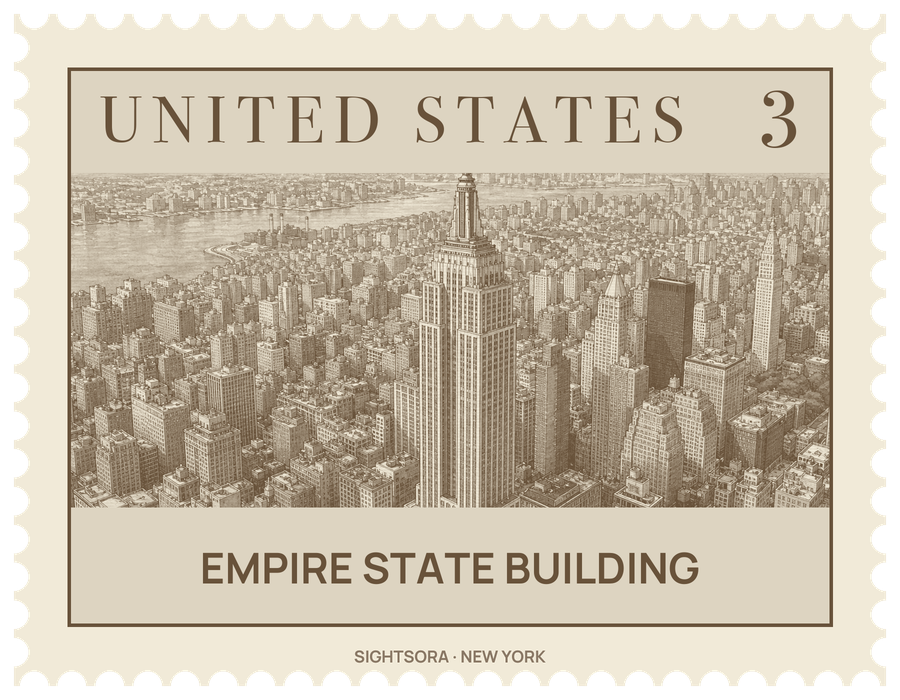
Designed by Shreve, Lamb & Harmon, it rose where the old Waldorf hotel and its Astoria neighbour had stood and opened in 1931, its name borrowed from the state's nickname, the "Empire State". Construction began in March 1930, and at times the builders added about four and a half floors a week; the frame was structurally complete on April 11, 1931, twelve days early, when Al Smith drove a final rivet of solid gold.
The building was planned at the height of a race between New York skyscrapers, and its design went through as many as fifteen versions. Zoning rules of 1916 required setbacks, so William F. Lamb worked from the top down and gave it its pencil-like profile: a five-storey base filling the lot, a shaft stepping back above it and a crown of sixteen storeys topped by a mast first meant as a mooring point for airships, an idea dropped because of high winds. Indiana limestone panels give the facade its pale blond colour, set against vertical strips of steel between the windows. The opening came during the Great Depression, and with little office space let, New Yorkers mocked it as the "Empty State Building"; in 1933 the film King Kong, with its giant ape climbing the tower, turned it into a screen landmark.
Visitors use a separate entrance at 20 West 34th Street, while the original three-storey lobby on Fifth Avenue keeps its two tones of marble, a zigzag terrazzo floor and an aluminium relief of the tower with rays spreading from its spire. On the way up, galleries on the second and 80th floors hold an interactive museum on the building's history, with historic artefacts and pop culture moments, and the 80th floor adds a skyline mural by the British artist Stephen Wiltshire.
There are two viewing levels above. The 86th floor has both an indoor gallery and an open-air deck, which stays open in rain, sun or snow, with heaters added in winter. A further lift climbs to the 102nd floor, a much smaller, fully enclosed observatory whose windows were enlarged to run from floor to ceiling in a redesign completed in 2019.
After dark the top of the tower is lit in changing colours. From October 12, 1977, the building has used its spire lighting to mark holidays, seasons and events, in team colours when New York sides play at home, and in tribute after deaths and disasters. An LED system installed in 2012 widened the palette from nine colours to more than 16 million and allows light shows synchronised to music.
Getting there
Two subway stations are close by: 34th Street – Herald Square one block west of the tower, and the 33rd Street station on Park Avenue, two blocks to the east. A PATH station stands at 33rd Street and Sixth Avenue. The observatory entrance and ticket office are on West 34th Street, between Fifth and Sixth Avenues.