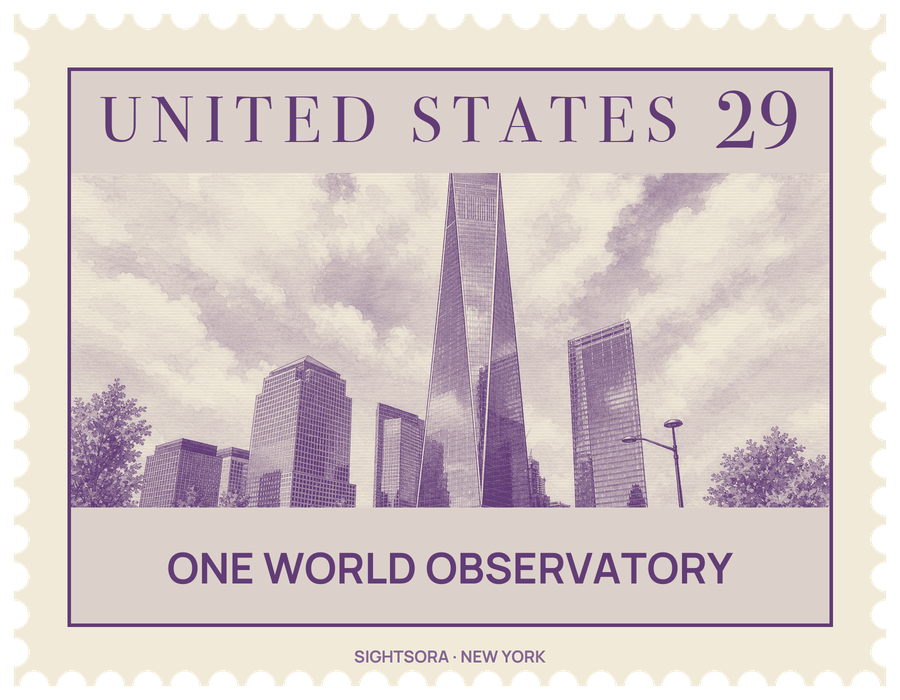
The observation deck sits 1,268 feet (386 m) above the street, and its viewing space is on the floor numbered 100. It opened in 2015, a few months after the building itself, which opened on November 3, 2014.
The tower carries the name of the original North Tower, destroyed in the attacks, and its architect was David Childs of the firm Skidmore, Owings & Merrill. Its footprint is a 200-foot square, almost the same as those of the Twin Towers. Above a 185-foot windowless concrete base, built to resist attacks at ground level, the corners are cut back so that the faces become eight tall triangles; halfway up the tower forms a perfect octagon, and it ends in a glass parapet turned 45 degrees from the base. On top stands a 407.9-foot mast, held by cables, that brings the total height to 1,776 feet (541 m), a number chosen to recall the year of the Declaration of Independence. At night a beam of light shines upward from the spire.
Floor numbering at the top is symbolic. The building has 94 actual stories but its top floor is numbered 104, and floor numbers 94 to 99 are skipped; a small area for the window-washing tracks is labelled floor 110, recalling the original tower's 110 floors. Besides the viewing floor, the observatory levels have places to eat and an events space, and staff use an interactive installation called City Pulse to tell visitors about the city laid out below. A plan for a restaurant in the spirit of the old Windows on the World, which crowned the original North Tower, was dropped.
Visitors to the observatory have their own entrances, separate from those used by office workers: one facing West Street, the other from the shopping mall, leading down to a security screening area below ground. The tower stands immediately north of the National September 11 Memorial & Museum, where the Twin Towers stood, so a visit is easily combined with the memorial pools. The lobby at ground level, 65 feet high, holds José Parlá's 90-foot mural ONE: Union of the Senses.
Getting there
An underground passage joins the tower to the Oculus, the World Trade Center Transportation Hub, where there is a PATH station and links to several subway stations; a tunnel also runs from the Oculus and the tower to Brookfield Place. At street level the building opens onto West Street, Vesey Street and Fulton Street.