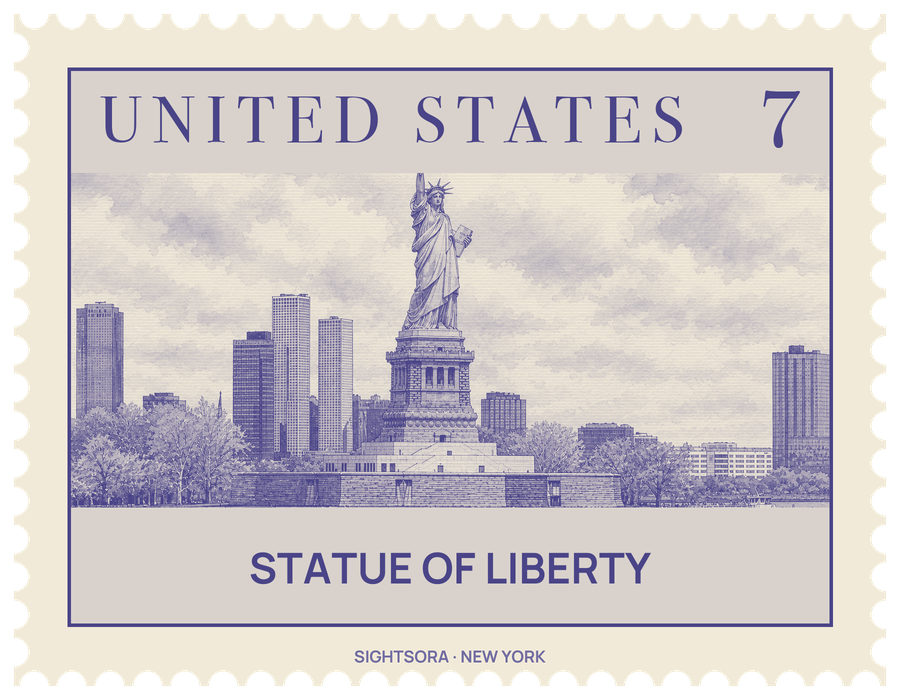
A gift from the people of France, it was designed by the sculptor Frédéric Auguste Bartholdi, with an iron framework by Gustave Eiffel, and was dedicated on October 28, 1886. Its official name is Liberty Enlightening the World, and the figure draws on Libertas, the Roman goddess of liberty. UNESCO listed it as a World Heritage Site in 1984.
The idea came from Édouard de Laboulaye, a French historian and opponent of slavery, who wanted to honour American independence, its democracy and the freeing of the slaves after the Civil War. France would pay for the statue and the Americans for the site and pedestal. Money was slow to come in on the American side until Joseph Pulitzer's newspaper, the New York World, promised to print the name of every donor, however small the gift. More than 120,000 people responded, and 80 percent of the money came in very small sums. The statue was built in Paris, taken apart, shipped to New York in crates in 1885 and reassembled on what was then Bedloe's Island, and its dedication set off the city's first ticker-tape parade.
Much of the meaning is in the details. The tablet in her left hand carries JULY IV MDCCLXXVI, the date of the Declaration of Independence, and at her feet, half hidden by the robe and hard to see from below, lies a broken chain. The crown has rays in place of the liberty cap Bartholdi first considered, and the torch was meant to stand for progress. Inside, Eiffel's skeleton carries a thin copper skin, heated and beaten into shape with wooden hammers, and attached loosely enough for the statue to move slightly in the wind. The copper was reddish-brown at first; by 1906 a green patina had covered it entirely, and when Congress approved money to paint the outside, public protest stopped the plan and engineers found the layer protected the metal.
The pedestal, designed by Richard Morris Hunt, rises from the star-shaped walls of Fort Wood, an army post built between 1807 and 1811. It mixes classical Doric doorways with touches drawn from Aztec architecture, and its concrete walls are faced with granite from Connecticut. Near the western tip of the island a group of statues by Phillip Ratner honours five people tied to the monument: Bartholdi, Eiffel, Laboulaye, Pulitzer and the poet Emma Lazarus, whose sonnet "The New Colossus" echoes the way immigrants arriving by sea came to see the statue, as a sign of welcome. A museum on the island, open to everyone who lands, opened in 2019.
Visitors can walk the grounds, enter the pedestal and climb to its observation level, and a limited number can go up the staircase inside the statue to the crown. The torch, replaced during the restoration for the 1986 centenary with a replica of Bartholdi's original and a flame covered in gold, sits above a balcony that has been closed to the public since the Black Tom explosion of 1916.
Getting there
Private boats may not dock at Liberty Island, so all visitors arrive by the official ferry, which sails both from the Battery in Lower Manhattan and from Jersey City's Liberty State Park, and also calls at Ellis Island when it is open.