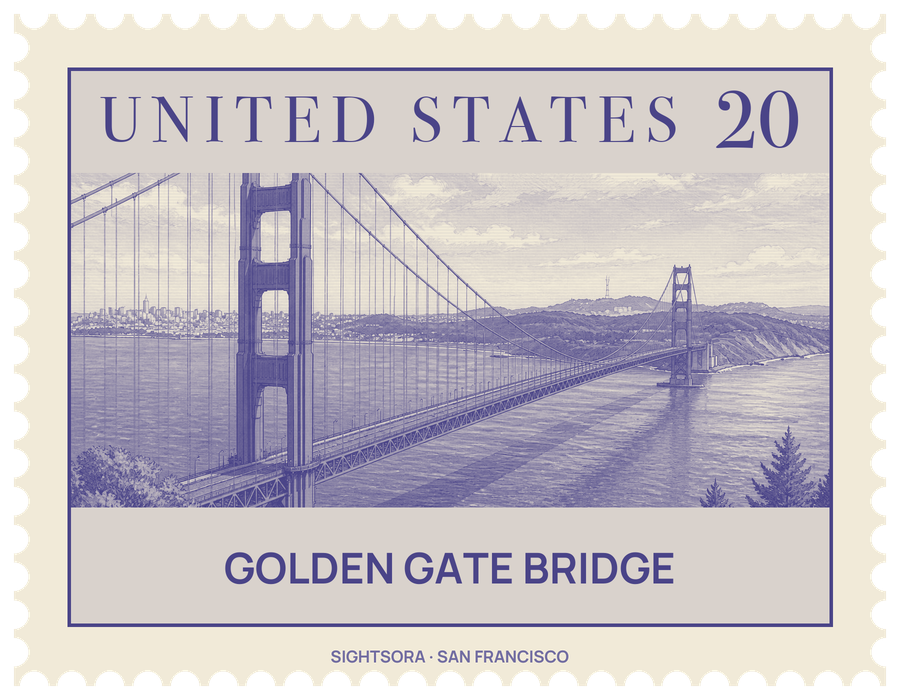
Its two towers stand 746 feet above the water, the main span between them is 4,200 feet long, and the whole bridge runs 8,981 feet from end to end. Building started in January 1933 and the public first walked across on May 27, 1937. The bridge carries US Route 101 and California State Route 1 as well as walkers and cyclists.
Many engineers had doubted a bridge could be built here at all, given the strong tidal currents, deep water in the channel, high winds and thick fog. Joseph Strauss led the project as chief engineer, but his first design, with heavy cantilevers on either side, was turned down as unattractive. The suspension design that was built came from Leon Moisseiff, and much of the mathematics was worked out by Charles Ellis, whose part was only formally recognised by the bridge district in 2007. Strauss did introduce movable safety netting under the workers; nineteen men who fell into it formed the Half Way to Hell Club. Eleven men still died, ten of them on February 17, 1937, when a scaffold broke through the net.
Much of the bridge's look is the work of Irving Morrow, a little-known residential architect who shaped the towers and designed the Art Deco details: the tower decorations, the streetlights, the railings and the walkways. He also chose the colour, an orange vermilion known as international orange, because it suits the surrounding landscape and makes the bridge easier to see in fog; the Navy had suggested black and yellow stripes instead. A team of painters keeps touching up the paint where it corrodes. When fog closes in, five foghorns on the bridge, in use since 1937, sound to guide ships: two deep-toned horns at the base of the south tower and three higher ones under the middle of the span.
Walkways run along both sides of the six traffic lanes. The eastern walkway is the main one and is shared by pedestrians and cyclists at some times of day, while the western walkway is for cyclists only, at the times they are kept off the eastern side. On the San Francisco end, next to the southeast parking lot, the Golden Gate Bridge Welcome Center has a gift shop, with a café, outdoor exhibits and toilets close by, and the Round House Café, an Art Deco building of 1938, stands beside the plaza. At the southern abutment, Charles Ellis designed a steel arch to carry the roadway over Fort Point, a masonry fort from before the Civil War that was kept rather than demolished. On the Marin side, Vista Point and its rest area, named after the landscape architect H. Dana Bower, are reached only from the northbound lanes. Harbor seals and sea lions live in the waters around the bridge.
Getting there
Golden Gate Transit buses cross the bridge throughout the week, and San Francisco Muni line 28 serves the southern end near the toll plaza and parking lot. The Marin Airporter, a private company, links San Francisco International Airport with Marin County over the bridge.