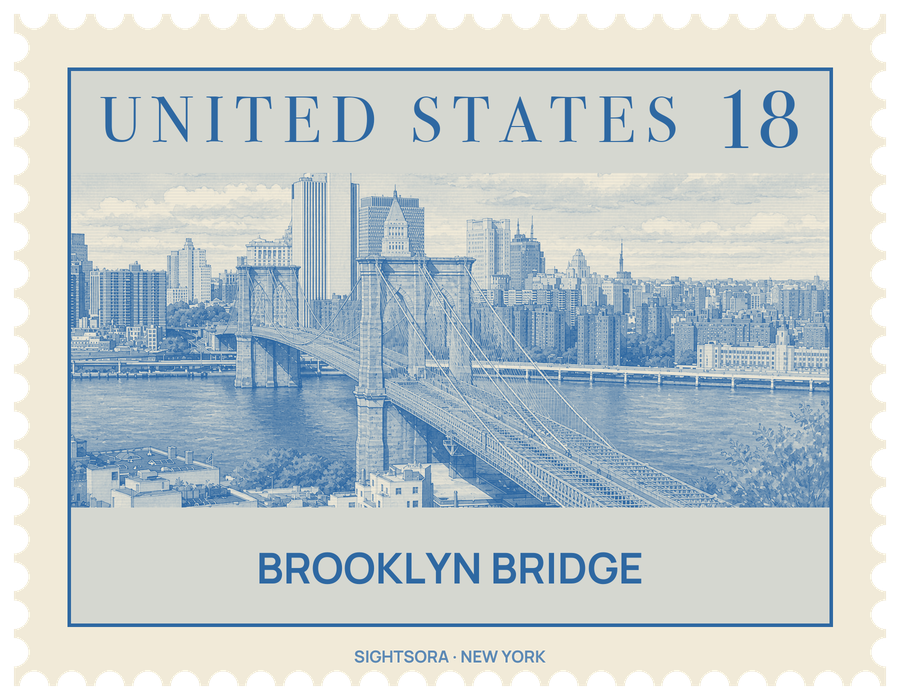
When it opened on May 24, 1883, it was the first fixed crossing of the river; until then the two cities, still separate, were linked only by ferries. Its main span measures 1,595.5 feet between the towers, and the deck stands 127 feet above high water so that ships could pass beneath. The design mixes a suspension bridge with a cable-stayed one: vertical suspenders hang from four main cables while diagonal stays run straight out from the towers.
The bridge was designed by John A. Roebling, who died in 1869 after his foot was crushed by a ferry during the final surveys. His son Washington Roebling took over as chief engineer, and work began on January 2, 1870, with two huge timber caissons sunk into the riverbed so that men could dig out the bottom in compressed air. Many workers fell ill with decompression sickness, then called "caisson disease", and Washington himself was left paralysed by it. From then on he followed the work through a telescope from his bedroom, while his wife, Emily Warren Roebling, carried his instructions to the site and took on much of the daily supervision for the next 11 years. She was the first to cross the bridge at its official opening.
Building it took thirteen years and cost an estimated 27 lives. Each main cable is made of 5,282 parallel galvanized steel wires bundled into 19 strands, and a contractor's fraud left inferior wire inside them; rather than start over, the engineers added 150 extra wires to each cable. The towers rise 278 feet, and on completion only the spire of Trinity Church stood higher among the city's buildings. In its early decades the bridge carried horse-drawn carriages, cable cars, elevated trains and trolleys; the rails were gone by 1950, and the roadways are open only to passenger vehicles, with buses and commercial vehicles barred.
For visitors the attraction is the walk. A promenade for pedestrians runs down the middle of the bridge, raised 18 feet above the traffic lanes on either side. At each tower it climbs to a balcony that overhangs the roadways slightly, and its iron railings came from Janes & Kirtland, the foundry that also made the dome of the United States Capitol. The path is mostly 10 to 17 feet wide but narrows where the main cables come down to its level, and these pinch points are also among the most popular places for photographs. Since 2021 cyclists have used a protected lane on the Manhattan-bound roadway, so the promenade is left to people on foot.
At night, LED fixtures strung along the main cables, known as the "necklace lights", trace the curve of the span, and the towers are floodlit. Under the Manhattan approach, a park named the Arches opened in May 2023 in part of the space beneath the brick vaults. The bridge is a National Historic Landmark and a New York City landmark, and in 2017 it was placed on UNESCO's tentative list of World Heritage Sites.
Getting there
On the Brooklyn side, the walkway starts from the median of Adams Street where it meets Tillary Street, or by stairs close to Prospect Street, between Cadman Plaza East and Cadman Plaza West. On the Manhattan end, walkers reach it from the crosswalks where the bridge meets Centre Street, or by a staircase leading up from Park Row.