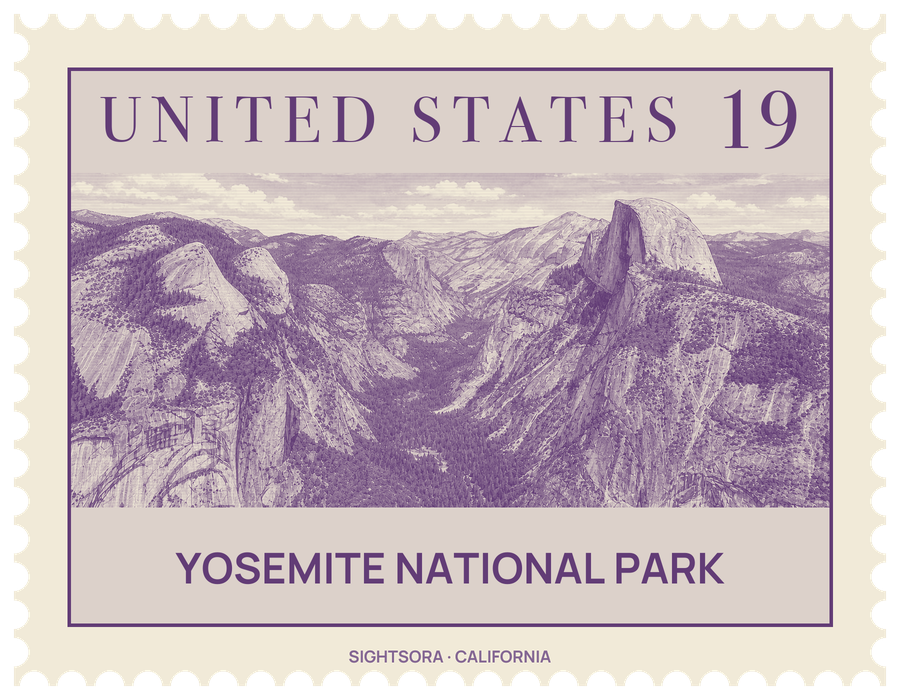
Its centrepiece, Yosemite Valley, is a U-shaped trough carved by glaciers out of a river-cut valley; it covers only about one percent of the park, yet most visitors spend most of their time there. In 1864 President Abraham Lincoln signed the Yosemite Grant, setting the valley and the Mariposa Grove aside for preservation and public use, and in 1890 Congress created the national park around them after a campaign led by John Muir. UNESCO made it a World Heritage Site in 1984.
The viewpoint at Tunnel View looks out over the valley. El Capitan, a granite cliff with a face 3,300 feet high, looms over it and draws rock climbers, who can be spotted on the wall in the snow-free months, while Half Dome rises 4,800 feet above the valley floor. Yosemite Falls drops 2,425 feet into the valley, Bridalveil Fall is often counted the most prominent of the valley's falls, and Ribbon Falls has a single sheer drop of 1,612 feet. The falls are fullest in April, May and June, when the snow melts. Horsetail Fall, a small winter stream over the eastern edge of El Capitan, can on rare clear evenings in February glow orange in the light of the setting sun.
Sentinel Dome rises 3,000 feet above the valley, and from Taft Point the valley floor lies 3,500 feet below. In the Wawona area, the Mariposa Grove holds about 200 giant sequoias, a species that grows larger in volume than any other tree; smaller groves stand at Tuolumne and Merced. Tioga Road is the park's best-known drive. Up in the high country, Tuolumne Meadows is known for rock and mountain climbing, among peaks such as Cathedral Peak, the red metamorphic summits of Mount Dana and Mount Gibbs, and Mount Lyell, the park's highest point at 13,120 feet. In the northwest, Hetch Hetchy Valley was dammed for San Francisco's water supply and has its own waterfall, Wapama Falls.
The park has over 800 miles of trails, from easy walks to multi-day backpacking routes. Black bears were once known for breaking into parked cars for food, so campgrounds have bear-proof lockers for storing it instead. In the valley itself, the Yosemite Valley Visitor Center, the Yosemite Museum next door and the Nature Center at Happy Isles explain its natural and cultural history, and a reconstructed Indian Village of Ahwahnee stands behind the museum. The Ahwahnee Hotel, built in 1926–27, and the Sierra Club's LeConte Memorial Lodge are National Historic Landmarks, and Camp 4, a walk-in campground, played a central part in the history of rock climbing.
In winter the high country is snowed in and many roads close, but the valley stays open. Downhill skiing is offered at the Badger Pass Ski Area, snowshoers and cross-country skiers can head out across much of the park, and the Ahwahnee Hotel has held its holiday Bracebridge dinner every year since 1927. In the warmer months visitors can raft the Merced River through the valley or cycle on more than 12 miles of paved paths there.
Getting there
Public transport is run by the Yosemite Area Regional Transportation System (YARTS) together with Amtrak, coming into the park from Merced, Fresno and Sonora, and from Mammoth Lakes and Lee Vining; the Merced service operates all year. Inside Yosemite Valley a shuttle bus operates, which helps in summer, when traffic is heavy and the valley's car parks often fill up.