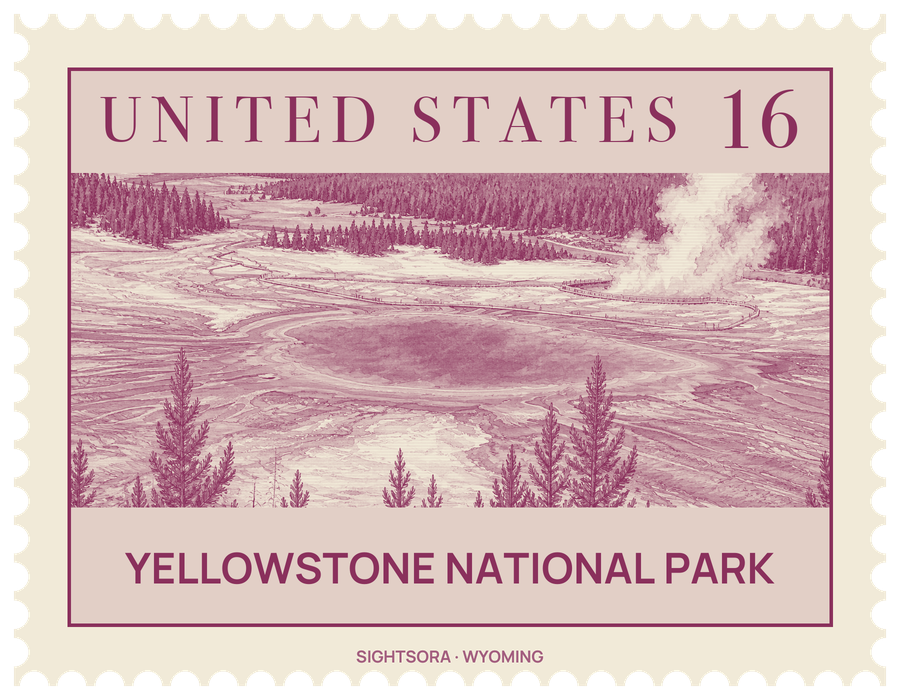
Under the park lies the Yellowstone Caldera, a collapsed volcano 45 by 28 miles across formed by an eruption 640,000 years ago, and the heat still rising from below feeds at least 10,000 geothermal features: geysers, hot springs, mudpots and fumaroles. President Ulysses S. Grant signed the act setting it apart as a public park on March 1, 1872, and UNESCO listed it as a World Heritage Site in 1978. The plateau averages about 8,000 feet above sea level, and forests, mostly of lodgepole pine, cover 80 percent of it.
The geyser basins are what most people come to see. In the Upper Geyser Basin stands Old Faithful, named by the Washburn expedition of 1870 because its eruptions came at regular intervals, and around it rise Castle, Lion, Beehive, Grand, Giant and Riverside geysers. Steamboat Geyser erupts in the Norris Geyser Basin. Boardwalks and paved paths have been laid around the thermal areas to keep visitors safe, and most of them are accessible to wheelchair users. In the hot water itself, mats of bacteria grow in strange shapes, and one of these microbes, Thermus aquaticus, gave scientists an enzyme now used to copy DNA.
The Yellowstone River has cut two colourful canyons through the volcanic rock as it flows north; in the Grand Canyon of the Yellowstone the layers of ancient lava are easy to pick out in the walls, and the Lower Falls drop 308 feet, the highest of the park's waterfalls. Yellowstone Lake, at 7,733 feet above sea level, has 110 miles of shoreline and fills part of the caldera, with a smaller caldera of its own at West Thumb. Mammoth Hot Springs in the north is home to Fort Yellowstone, built by the army after it arrived in 1886, and the whole district is a National Historic Landmark. Mount Washburn, the most prominent summit on the plateau, has a fire lookout tower with exhibits and a public observation deck.
Wildlife is the other reason to come. The park holds grizzly and black bears, wolves, coyotes and cougars, along with free-roaming herds of bison and elk, moose, pronghorn, bighorn sheep and mountain goats. Wolves had been all but wiped out by park hunters early in the 20th century and were brought back in the 1990s with animals from Canada. Black bears are seen most often in the northern ranges and in the Bechler area in the southwest corner. Among the birds are bald eagles, ospreys and trumpeter swans, and Yellowstone cutthroat trout draw anglers to the rivers, where native fish must be released.
Robert Reamer's Old Faithful Inn, put up between 1903 and 1904, set the rustic style later used across national parks and is itself a National Historic Landmark. Concessionaires run nine hotels and lodges, and there are a dozen campgrounds and 1,100 miles of hiking trails; camping in the backcountry can be reached only on foot or horseback. Facilities at Old Faithful, Canyon and Mammoth Hot Springs get very busy in summer, and traffic can stop for long stretches when drivers halt to watch animals. In winter most roads close to wheeled vehicles, and visitors travel on guided snowmobile and snow coach tours.
Getting there
Five entrances lead into the park, and 310 miles of paved road link the main sights. There is no public transport inside the park, but tour companies run guided trips. The nearest airports are at Bozeman and Billings in Montana, Jackson and Cody in Wyoming, and Idaho Falls; Salt Lake City, 320 miles to the south, is the closest large city. Gateway towns include West Yellowstone and Gardiner in Montana and Cody in Wyoming, and the Beartooth Highway gives high-altitude access from the northeast.