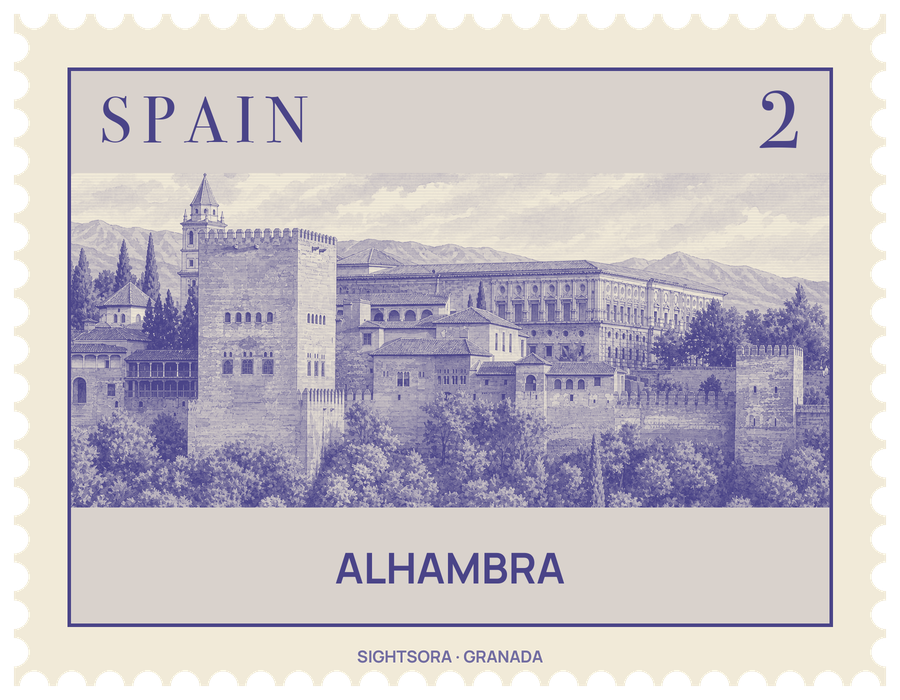
Its name comes from the Arabic for "the red one", after the reddish rammed-earth walls coloured by iron oxide in the local clay. Muhammad I Ibn al-Ahmar, founder of the Nasrid Emirate of Granada, began building it in 1238, and his successors kept adding to it; the royal palaces took most of their character under Yusuf I and Muhammad V in the 14th century. Together with the Generalife, it was listed as a UNESCO World Heritage Site in 1984.
In Nasrid times the hill was a self-contained town with a congregational mosque, baths, houses, workshops and a tannery, fed by the Acequia del Sultan, a canal that still draws water from the Darro River about 6.1 kilometres upstream. In January 1492 the last sultan, Muhammad XI, surrendered Granada to Ferdinand and Isabella, who moved into the palaces; it was here, in the Hall of the Ambassadors, that Christopher Columbus put his plan for an Atlantic voyage to them. Centuries of neglect followed, and in 1812 Napoleon's retreating troops blew up eight towers. Washington Irving's Tales of the Alhambra of 1832 drew Romantic travellers back, and restoration has continued ever since.
The heart of a visit is the Nasrid Palaces, entered from the west through the Mexuar, the council hall where the sultan heard petitions. Next comes the Comares Palace, built around the Court of the Myrtles, whose long reflecting pool is lined with myrtle hedges. Inside the Comares Tower, the Hall of the Ambassadors was the throne room: a square chamber 18.2 metres high under a wooden ceiling of 8017 pieces that represents the seven heavens, with windows on three sides.
The Palace of the Lions, built under Muhammad V, surrounds a courtyard of slender columns set singly and in groups of two or three, with the Fountain of the Lions at its centre: a basin on twelve marble lions, ringed by a poem by Ibn Zamrak. Off the courtyard, the Hall of the Abencerrajes has a star-shaped muqarnas cupola, and the Hall of Two Sisters a dome of at least 5000 carved pieces. The Mirador de Lindaraja beyond it keeps fine original tilework and stucco. Throughout the palaces, tile covers the lower walls and carved stucco the upper ones, much of it lettered with poetry and the Nasrid motto "there is no victor but God". The stucco and wood that look pale today were once painted red, blue and gold.
Beyond the palaces, the Partal Palace with its portico over a long pool is the oldest Nasrid palace still standing, and gardens run along the northern walls. At the western tip, the Alcazaba fortress is the oldest part of the complex; from its Torre de la Vela, 25 metres high, the flag of Ferdinand and Isabella was raised on 2 January 1492. In the middle of the site, Charles V had Pedro Machuca design a Renaissance palace: a stone square around a circular courtyard, begun in 1527 and left roofless until the 20th century. It holds the Alhambra Museum, where the Vase of the Gazelles is displayed, and the Fine Arts Museum of Granada.
Outside the walls to the east lies the Generalife, a Nasrid country estate of garden courtyards with pavilions, approached through landscaped gardens from the 20th century. Most visitors arrive the way the modern route runs, up through the Alhambra Woods on the south side, entered by the Renaissance Puerta de las Granadas of 1536. The sequence of the original town ran the other way, from the Puerta de la Justicia, the main Nasrid gate built in 1348, with a carved hand on its outer arch.