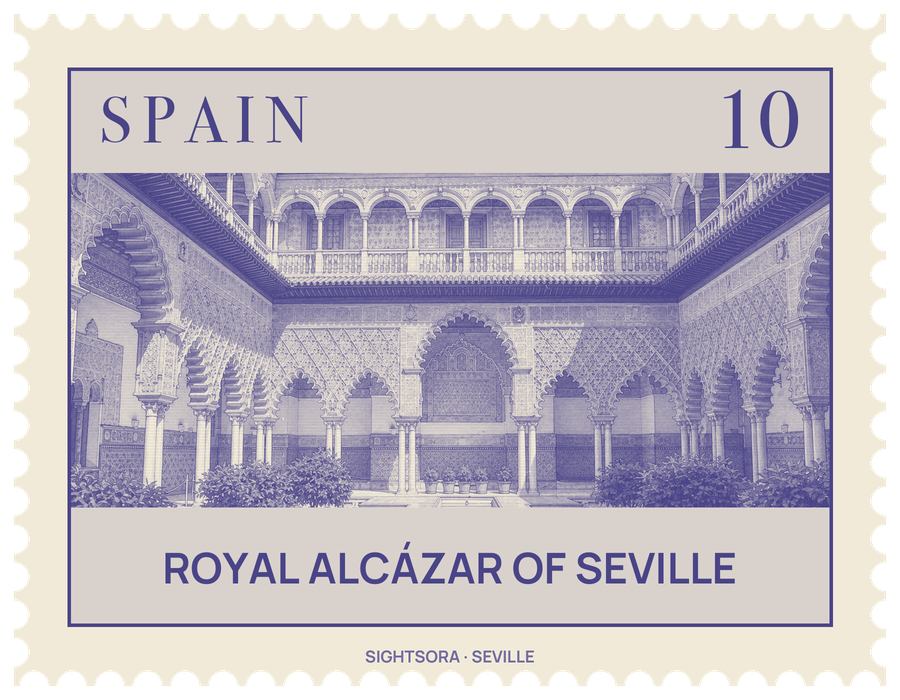
Its centrepiece is the palace Pedro I of Castile built in the 1360s in a richly ornamented Mudéjar style. The Spanish royal family still uses it as an official residence when in Seville, and their upper-floor rooms are run by Patrimonio Nacional, and in 1987 UNESCO listed it as a World Heritage Site together with its two neighbours, the General Archive of the Indies and the cathedral.
The story begins in 913–914, when Abd al-Rahman III built a fortified square enclosure on the site of a Visigothic basilica. The Abbadids enlarged it in the 11th century, and the Almohads, who made Seville their capital in al-Andalus, rebuilt it from around 1150 as a cluster of about twelve palaces. Little of that period survives above ground, but Almohad remains survive in three courtyard buildings: the Patio del Crucero, the Patio del Yeso and the Palacio de la Contratación. After Ferdinand III of Castile took the city in 1248, Castilian kings remade the site with new palaces, among them a Gothic palace for Alfonso X.
Visitors enter through the Puerta del León, named after the tiled heraldic lion of 1892 above the arch, into the Patio del León, where a stretch of Almohad wall with three arches leads on to the Patio de la Montería and the façade of Pedro I's palace. To one side, the Sala de Justicia, a square Mudéjar hall built under Alfonso XI with a fountain at its centre, opens into the Patio del Yeso, a late 12th-century courtyard with a pool and lace-like plaster arches.
Inside Pedro I's palace, the Patio de las Doncellas has a long reflecting pool flanked by sunken gardens; buried under a marble floor between 1581 and 1584, they were dug out again during excavations from 2002 to 2005 and restored. The Renaissance upper storey was added for Charles V. The Hall of the Ambassadors, finished in 1366, is a square room under a dome rebuilt in 1427, with triple horseshoe arches on marble columns, tiled lower walls and dense plasterwork above; Charles V married Isabella of Portugal here in 1526. The palace closely resembles the Nasrid palaces of the Alhambra, and Muhammad V of Granada, Pedro's ally, probably sent craftsmen to help decorate it.
Below the Patio del Crucero, the Baños de Doña María de Padilla are a long underground water basin under Gothic ribbed vaults, a survivor of Alfonso X's palace. Tiles are everywhere in the Alcázar, both the older raised-ridge arista type and painted majolica, and the Gothic Palace has tilework by Cristóbal de Augusta with animals, cherubs and flowers.
The gardens spread out behind the palaces, from the Mercury Pond and the Jardín de la Danza to the Jardín de las Damas, the Pavilion of Charles V and the English Garden. In the 17th century the Italian Vermondo Resta turned an old Muslim wall into the Galería de Grutesco, a loggia for looking out over the gardens. Film crews have used the Alcázar for Lawrence of Arabia, Kingdom of Heaven and Game of Thrones.