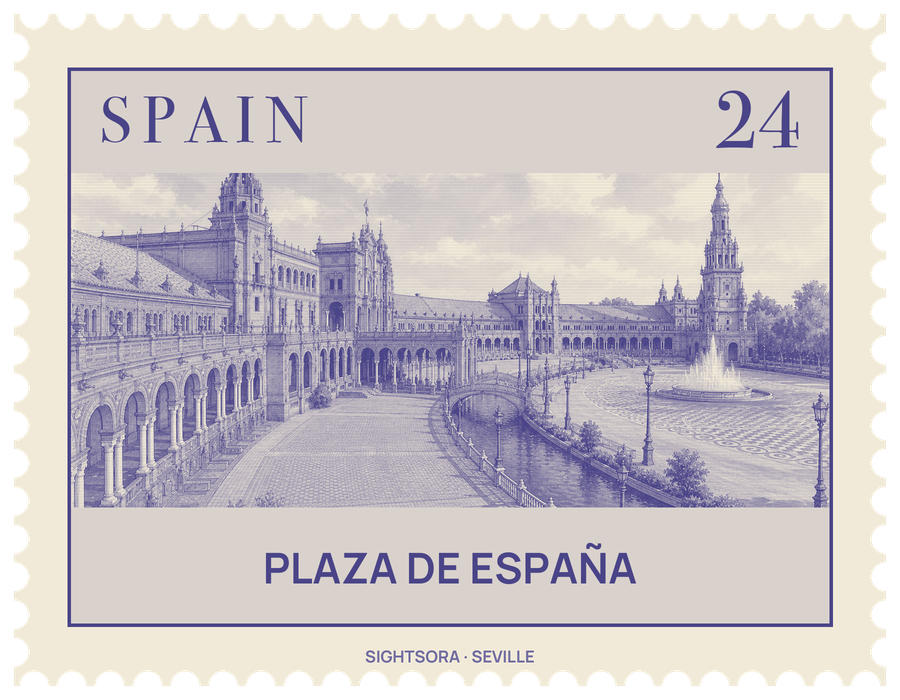
Its architect, Aníbal González, mixed 1920s Art Deco with Renaissance Revival, Baroque Revival and Neo-Mudéjar forms, and the result is a landmark of the Regionalism style in Spanish architecture.
For the exposition the whole southern end of the city was remade as gardens and broad boulevards. At their centre is María Luisa Park, laid out by Jean-Claude Nicolas Forestier in a 'Moorish paradisical style', with tiled fountains, pavilions, ponds and benches set among palms, orange trees and Mediterranean pines. Toward the far end of the park, some of the grandest mansions from the fair became museums; the most distant holds the city's archaeology collections, above all Roman mosaics and objects from nearby Italica.
Four bridges cross the moat into the plaza, each standing for one of the ancient kingdoms of Spain, and the Vicente Traver fountain plays at the centre. Around the walls runs a series of tiled alcoves, one for each Spanish province, where visitors like to be photographed in front of their own home province. Beside each alcove are covered bookshelves that work as a small free lending library, often stocked with books about that province and with novels left by other visitors. The buildings themselves serve as offices for government agencies.
Between 2007 and 2010 Seville City Council restored the plaza to the form Aníbal González had planned, recovering ceramic streetlights, benches and paving and rebuilding lost pieces from old photographs and postcards. Film crews have long used it: it appears in Lawrence of Arabia (1962), the 2002 Star Wars film Attack of the Clones used it for exterior shots of Theed, a city on the planet Naboo, and it was a location for The Dictator (2012).