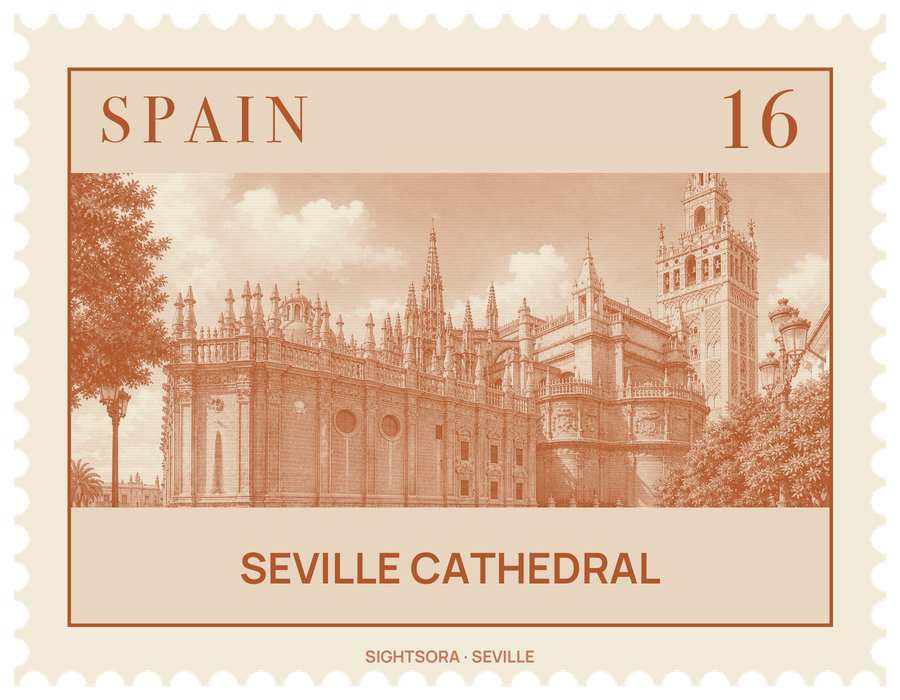
The Gothic church that replaced the prayer hall is 126 metres long and 76 metres wide, and its central nave is the longest of any cathedral in Spain. In 1987 UNESCO listed it as World Heritage together with the neighbouring Alcázar and the General Archive of the Indies.
Caliph Abu Yaqub Yusuf ordered the mosque in 1172, and it was finished in 1198. After Ferdinand III took Seville in 1248, the building was turned into a church, its interior divided into chapels and much of its eastern half given to a royal chapel. In July 1401 the city's leaders resolved to replace it with a new cathedral that would display the wealth Seville had gained as a trading centre; local tradition credits the chapter with wanting a church so grand that people would think its builders mad. A Dutch master, Ysambert, and then a French one, Carlín, were among the builders who worked on it for over a century, and the cathedral chapter dates the setting of the final stone on the crossing lantern to 10 October 1506. The lantern fell in 1511 and was rebuilt with intricate lierne vaulting by 1519; an earthquake brought down the crossing again in 1888.
The Giralda rises about 105 metres. It was begun in 1184, designed to resemble the Koutoubia minaret of Marrakesh, and in the 16th century Hernán Ruiz the Younger crowned it with a Renaissance belfry. The bronze figure on top, El Giraldillo, was placed there in 1568 as a sign of the triumph of the Christian faith; a replica stands in front of the south door. From Calle Alemanes, the Door of Forgiveness leads into the orange-tree courtyard; it keeps the horseshoe arch of the mosque, and the Door of the Lizard is named after the stuffed crocodile hanging from its ceiling.
Inside, the eye goes first to the boxlike choir that fills the middle of the nave and to the huge Gothic retable carved with scenes from the life of Christ, begun by Pieter Dancart in 1482. A 14th-century Gothic crucifixion group by an unknown artist crowns the retable; its Christ, the Cristo del Millón, takes its name from a tradition of a million graces granted to the people of Seville during epidemics. The cathedral has 80 chapels. The royal chapel holds Ferdinand III, Alfonso the Wise and Peter the Cruel, and the tomb of Christopher Columbus, who lies here with his son Diego, is also inside. In the baptistery Chapel of Saint Anthony hangs Murillo's The Vision of St. Anthony of 1656, whose cut-out figure of the saint was stolen in 1874 and recovered from a New York dealer in 1875.
Fifteen doors open through the four façades. On the west side, the Door of Baptism carries a 15th-century relief of the baptism of Jesus from the workshop of Lorenzo Mercadante, and the Door of Saint Michael has Nativity sculptures by Pedro Millán and serves the Holy Week processions. Millán also made the painted terracotta image, from around 1500, in the chapel of the Virgen del Pilar beside the Puerta de la Granada, a devotion linked to the Aragonese who came with Ferdinand III. Twin organs by Aquilino Amezua, installed in 1901–1903, are now played from a single console between them, and the cathedral also keeps the Biblioteca Capitular y Colombina.