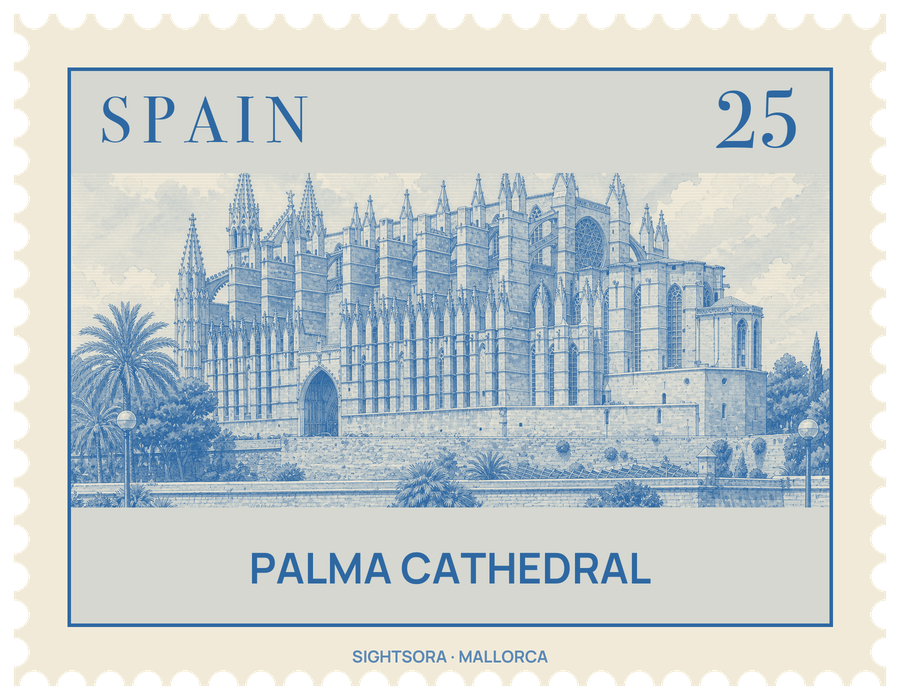
Work began on the site of the main mosque soon after King James I took the city, then called Madina Mayurqa, from its Almohad rulers in 1229, and building continued into the 17th century. The cathedral is 121 metres long and 40 metres wide, and it is the seat of the diocese of Mallorca.
Inside, three parallel naves end in three apses; there is no transept or ambulatory, so the plan is not cross-shaped at all. The central nave is twice as tall as the two side naves, and the pillars holding up the vaults are remarkably slender, their width just a twelfth of the vault they carry. The great rose window at the east end, nearly 14 metres across, fills almost the full width of the central nave. Outside, flying buttresses and pinnacles climb in three ranks: chapels and sacristy, then the side naves, then the main nave. Apart from its main portal, the west façade was rebuilt in a French-inspired neo-Gothic manner in the 19th century, when it gained its gable.
The oldest surviving part, the Chapel of the Holy Trinity, was completed in 1327 as a burial place for the kings of Mallorca, and the bell tower was finished in 1498, around the time the naves were vaulted. In 1903 Antoni Gaudí was invited to lead a restoration. He moved the choir stalls and screen out of the middle of the nave to the side walls of the presbytery, hung a large canopy above the altar, cleared away Baroque and Gothic altarpieces so that the 13th-century bishop's chair and the royal tombs stood out, reopened bricked-up windows to let in daylight and gave the choir ceramic panels decorated with heraldic designs. Disputes with the local authorities ended his work in 1914, with his plans left incomplete.
At the end of the central nave, the Royal Chapel holds the marble tombs of the Mallorcan kings James II and James III next to a white marble episcopal throne of 1346. Sixteen chapels line the nave, covering almost every architectural style used on the island since the cathedral was begun: one dedicated to Sant Jeroni is Plateresque, another, to Our Lady of the Crown, is Churrigueresque. Between 2001 and 2006 the Mallorcan artist Miquel Barceló reworked the chapel dedicated to Sant Pere and the Holy Sacrament, which closes the southern nave, lining its apse with Italian ceramic that sets the Miracle of Loaves and Fishes and the Wedding at Cana in a local scene, and fitting grisaille glass meant to suggest the sea floor. The 110 choir stalls that Gaudí moved are fine examples of Catalan Gothic woodwork.