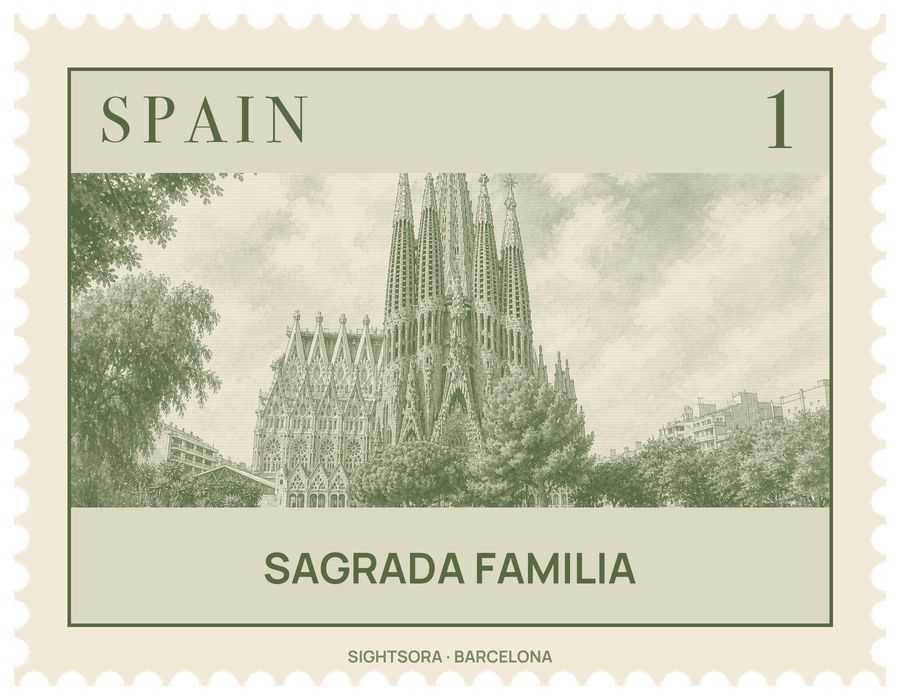
Gaudí took over the project in 1883, discarded the conventional Gothic revival plan he inherited and spent the rest of his life on it; he is buried in the crypt. In 2005 its Nativity façade and crypt were added to the UNESCO World Heritage listing of the works of Antoni Gaudí, and in 2010 Pope Benedict XVI consecrated the church as a basilica.
The idea came from a Barcelona bookseller, José María Bocabella, who wanted an expiatory temple paid for entirely by donations, and private gifts and visitors' tickets have funded the building ever since. Progress was slow: when Gaudí died in 1926 only a fraction of it stood, and during the Spanish Civil War in 1936 his workshop was set on fire and many of his plans and plaster models were lost. Later architects worked from reconstructed drawings, and from the 1980s computers helped turn his complex geometry into stone cut off-site.
Three great façades tell the story of Christ's life. The Nativity façade on the east side is the one Gaudí saw built, crowded with carved figures and a cypress tree standing for the tree of life. The Passion façade on the west, begun in 1954 to a 1917 design, is its opposite: gaunt, angular sculpture by Josep Maria Subirachs showing the scourging and the Crucifixion. The Glory façade to the south is meant to become the main entrance.
Gaudí planned eighteen spires in all: one for each apostle, four for the evangelists, one for the Virgin Mary and the highest of all for Christ. The central Tower of Jesus Christ, topped by a giant cross, reached its full height of 172.5 metres on 20 February 2026; Gaudí wanted it to stay one metre lower than Montjuïc hill, so that a building made by people would not outdo the work of God. The evangelists' spires carry their symbols: a winged bull, a winged man, an eagle and a winged lion.
Inside, the plan is a Latin cross with five aisles, and the columns are designed to branch out near the ceiling like trees, so the nave feels more like a stone forest than a church hall. A column that starts square turns into an octagon, then a sixteen-sided shape and finally a circle as it rises. The vaults over the central nave are forty-five metres high, and from the main entrance a visitor can follow the vaults climbing towards the apse. Gaps in the apse floor look down into the crypt.
Getting there
The basilica is in the Eixample district; city bus lines B20 and B24 stop close by, as do lines 19, 33, 34, 43, 44, 50 and 51.