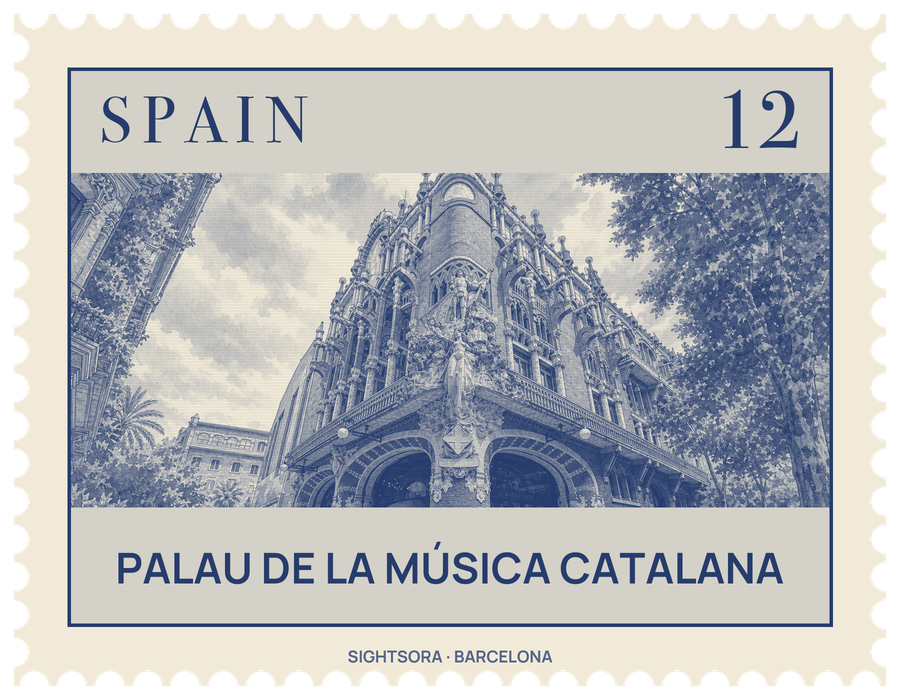
Lluís Domènech i Montaner designed it in the Catalan modernista style for the Orfeó Català, a choir society dating from 1891 and closely tied to the Renaixença, the Catalan cultural revival. Building ran from 1905 to 1908, and the hall opened on 9 February 1908. In 1997 it was declared a UNESCO World Heritage Site together with the Hospital de Sant Pau.
Curves, organic shapes and floral ornament dominate, yet the building was planned around function and used steel framing, then a modern technique. Patrons asked for materials and crafts that expressed Catalan identity, so the architect handed much of the sculpture and decoration to local artisans and let them work freely. On the main façade, two rows of columns on the second-level balcony are each clad in their own pattern of glazed tile and crowned with a candelabrum; above them stand busts of Palestrina, Bach and Beethoven, with Wagner on the side. Miguel Blay's sculptural group on the corner stands for Catalan music, and a mosaic by Lluís Bru showing members of the Orfeó Català runs along the top, though the narrow street makes it hard to see.
The original entrance opened through two arches into a vestibule whose ceiling carries star-shaped ceramic mouldings; marble staircases with yellow glass balusters climb to the upper floor. Guests generally come in through the foyer created in the 1982–1989 works by Oscar Tusquets and Carles Díaz, where a bar sits between brick pillars under hanging stained glass and a glass case holds the society's embroidered banner. Upstairs, the double-height Lluís Millet hall gives a much closer view of the tiled columns outside its windows than the street does, and it is lined with bronze busts of musicians linked to the Palau, among them Pablo Casals.
The concert hall itself holds about 2,200 people. Its side walls are mostly arched stained glass, and overhead a skylight by Antoni Rigalt drops an inverted dome of gold ringed with blue, a sun in a sky, surrounded by a choir of young women. The stage arch, sculpted by Dídac Masana and Pablo Gargallo, sets folk music against classical: a bust of the choir director Anselm Clavé under a stone tree on the left, and Wagner's Valkyries riding above a bust of Beethoven on the right. Behind the stage, eighteen figures known as the muses emerge from the wall, their upper bodies carved by Eusebi Arnau and their skirts laid in mosaic by Lluís Bru, each playing a different instrument; winged horses honouring Pegasus watch from the upper balcony.
The restoration of 1982–1989 added a six-storey neighbouring building for dressing rooms, a library and an archive, using stone, brick, iron, glass and ceramics as Domènech i Montaner had. The Petit Palau, opened in 2004, lies 11 metres beneath the square beside the church next door and seats 538, with acoustics that can be adjusted for music or speech. Concerts cover jazz and Catalan song as well as symphonic and chamber music, and visitors who are not attending a concert can tour the building.