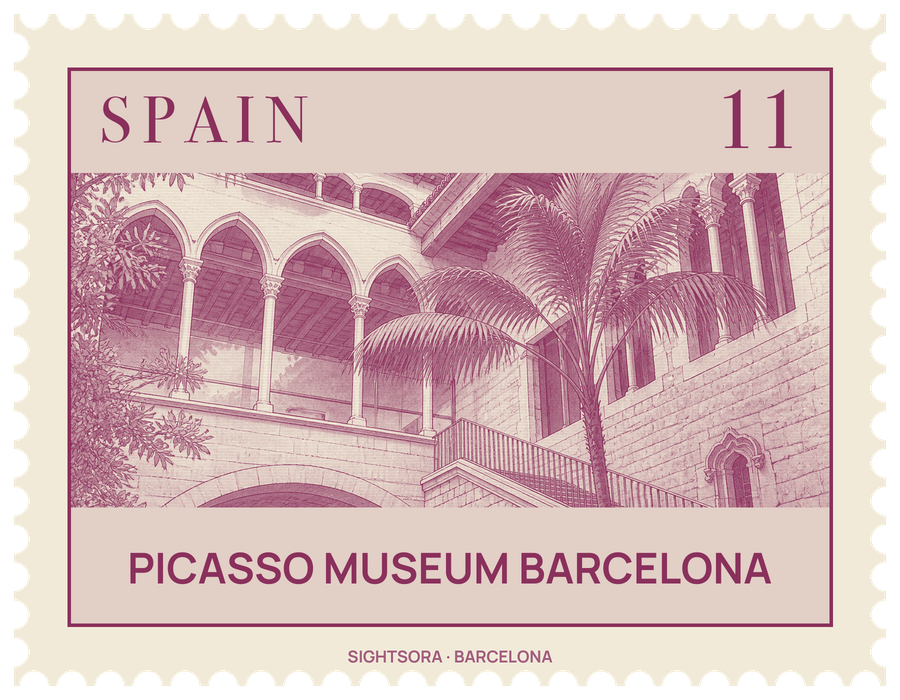
The buildings date from the 13th and 14th centuries and follow the Catalan Gothic pattern of a courtyard with an open staircase climbing to the main floor. The museum opened on 9 March 1963, while Picasso was still alive, and the Government of Catalonia has since declared it a museum of national interest.
The museum presents itself as the place to understand Picasso's formative years, and that is where its strength lies. Most of the paintings date from 1890 to 1917, running from his childhood in Málaga and Corunna through his training in Barcelona and Madrid to the Blue Period of 1901 to 1904. Two early major works, The First Communion of 1896 and Science and Charity of 1897, are among the highlights, and the collection also traces his ties with Barcelona, which began in his youth and lasted until his death.
The idea came from Jaume Sabartés, Picasso's friend and secretary since 1899, who first had Málaga in mind; Picasso himself suggested Barcelona instead. Sabartés gave 574 works from his own collection, and because Picasso opposed the Franco regime, it was called the Sabartés Collection when it first opened its doors in the Palau Aguilar. In 1970 Picasso made a last personal gift of 920 works, including school books and academic pieces that his family had kept since he moved to France.
After 1917 the collection becomes thin, with one large exception: the complete Las Meninas series of 1957, Picasso's variations on that famous canvas, which came through Sabartés' bequest of 58 paintings. Alongside the paintings and drawings there are sections for engraving and ceramics, the latter including pieces given by Picasso's widow, Jacqueline.
Walking through the museum means passing from one palace into the next. The Palau Aguilar was the first, followed by the Palau del Baró de Castellet, with a neo-classical main floor of marble and painted reliefs, and the Palau Meca, with medieval painted coffered ceilings. Casa Mauri and the Palau Finestres, added in 1999, hold temporary exhibitions; the museum regularly shows Picasso alongside other artists and runs guided visits of the collection. A newer building by Jordi Garcés on Sabartés square, behind Montcada Street, houses the library, archives and visitor services.