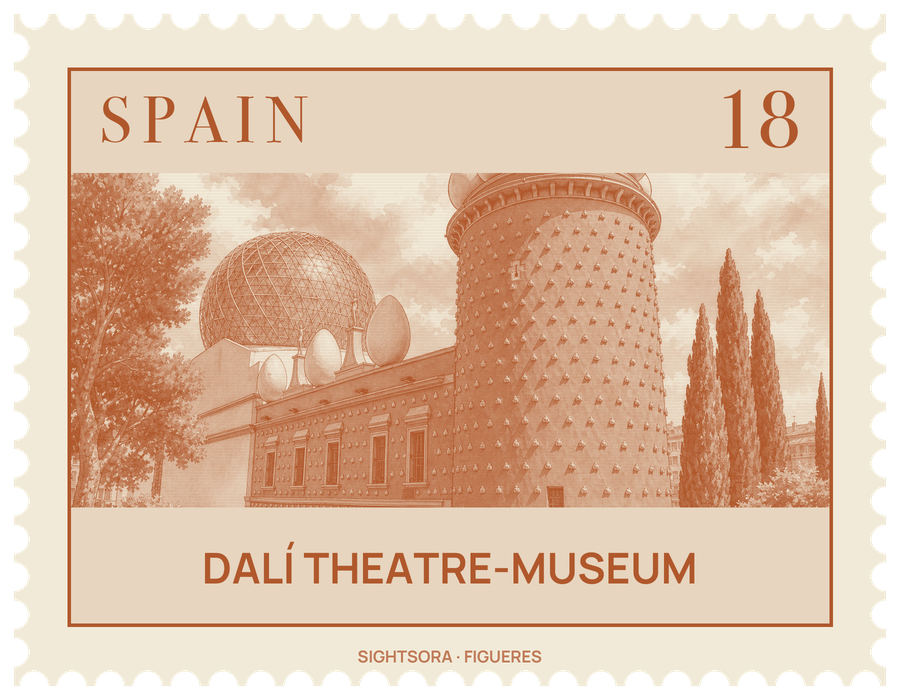
The theatre was where one of his first public exhibitions had been shown when he was young; fire gutted it in the Spanish Civil War, and it stood as a ruin for years. In 1960 Dalí and the mayor agreed to rebuild it, the city council approved the plan in 1968, and the museum opened on 28 September 1974, with Alexandre Bonaterra and Joaquim de Ros i Ramis as architects. Dalí lived there from 1984 to 1989. He wanted the whole place to work as a single labyrinthine surrealist object that would leave visitors feeling they had had a theatrical dream.
The Fundació Gala-Salvador Dalí divides the museum into two parts. Rooms 1 to 18 are the old theatre as Dalí reshaped it, meant to be read as one artwork in which every element belongs to the whole. Later extensions hold rooms for temporary exhibitions and two rooms of jewellery designed by Dalí, and spaces added near the end of his life and after his death include the Crypt and the Torre Galatea. The collection spans his whole career, from early experiments through the surrealist works to the last years, and also includes art by others he admired, from El Greco to Marcel Duchamp.
A glass geodesic dome rises over the old stage. Where the audience once sat is now a courtyard open to the sky, with nude figures standing in the former balcony windows and, near the centre, the Cadillac plujós, a full-sized car with an installation inside inspired by Rainy Taxi of 1938. The best known room is the Mae West room, where a lips-shaped sofa and other furnishings come together as the actress's face when seen from one particular point. Other pieces made for the museum include the Palace of the Wind room and the Monument to Francesc Pujols, and in another room a bathtub, a side table and a lamp hang upside down from the ceiling.
Among the paintings are Port Alguer (1924), Leda Atomica (1949), Soft self-portrait with grilled bacon (1941), Galatea of the Spheres (1952), Basket of Bread (1945) and the portrait of Gala called Galarina. An extension shows his optical illusions, stereoscopic and anamorphic works and holograms, and the works of his last years end with The Swallow's Tail (1983), the final oil painting he made. A second-floor gallery is given to his friend Antoni Pitxot, who directed the museum after Dalí's death.
Because the building is complex, the museum recommends downloading the visit plan, which is offered in ten languages. Visitors in wheelchairs or with reduced mobility use the entrance on Plaça Gala-Dalí, beside Wolf Vostell's sculpture Obelisc de la Televisió, and should tell the museum's access staff beforehand.