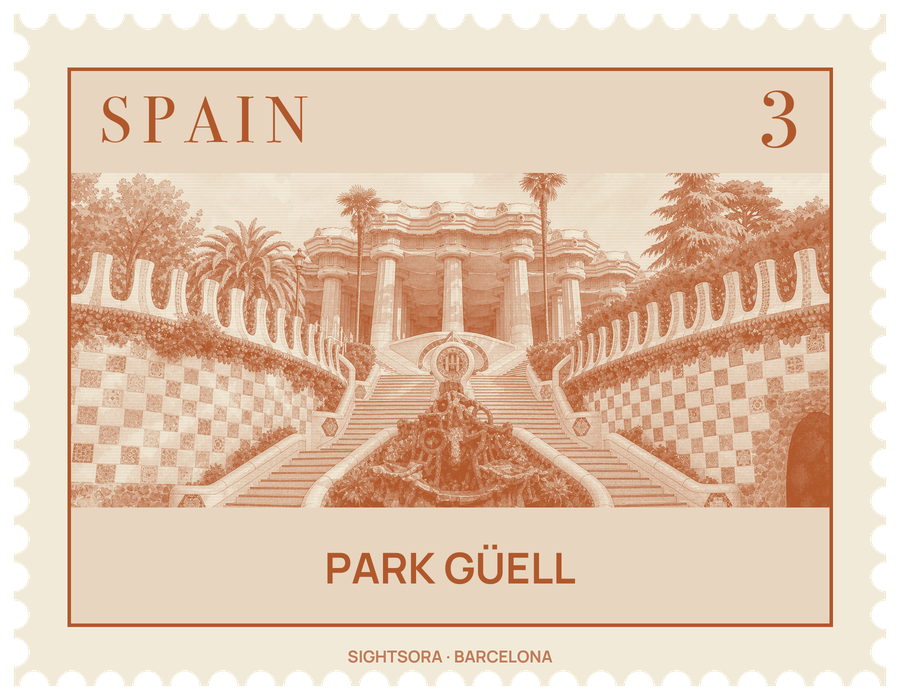
Building went on from 1900 to 1914 and the park opened to the public in 1926. UNESCO listed it in 1984 as one of the Works of Antoni Gaudí, noting how it mixed Arts and Crafts, Symbolism, Expressionism and Rationalism and pointed ahead to 20th-century Modernism.
It was planned as something quite different: a private estate of luxury houses for the bourgeoisie, modelled on the English garden city, which is why the name uses the English word "Park". The hill, then called Muntanya Pelada, was to carry sixty triangular plots sold on the strength of clean air and views. Buyers found it too far from the centre and only two houses went up, neither of them by Gaudí. One, a show home from 1904, was bought by Gaudí himself, who lived there from 1906 with his father and niece; designed by Francesc Berenguer i Mestres, it has been the Gaudí House Museum since 1963 and needs its own ticket.
The visit starts at two fanciful gatehouses, the Porter's Lodge pavilion, one of which holds a permanent display of the Barcelona City History Museum. Steps lead up past the mosaic salamander nicknamed El Drac to a hall of columns with tiled ceilings, and above it the main terrace, edged by a long bench that winds like a sea serpent. The bench was designed by Josep Maria Jujol, and its curves form small bays where people sit facing each other.
Elevated paths, first laid out for carriages, wind through the rest of the grounds. Gaudí built them from local stone, with leaning columns and vaults shaped like tree trunks and inverted catenary arches carrying the load. At the top of the park a stair climbs to El Turó de les Tres Creus, a calvary of three stone crosses, looking out to the sea, Montjuïc, Torre Glòries and the Sagrada Família.
The paths are uneven and some ramps are steep, so the park suggests that visitors with reduced mobility enter from the Carretera del Carmel. Non-native parrots live in the trees, and short-toed eagles and hummingbird hawk moths are seen here.
Getting there
The nearest metro stations are Vallcarca and Lesseps, both a walk away from the park rather than at its gates; city buses and tour buses also stop near the park.