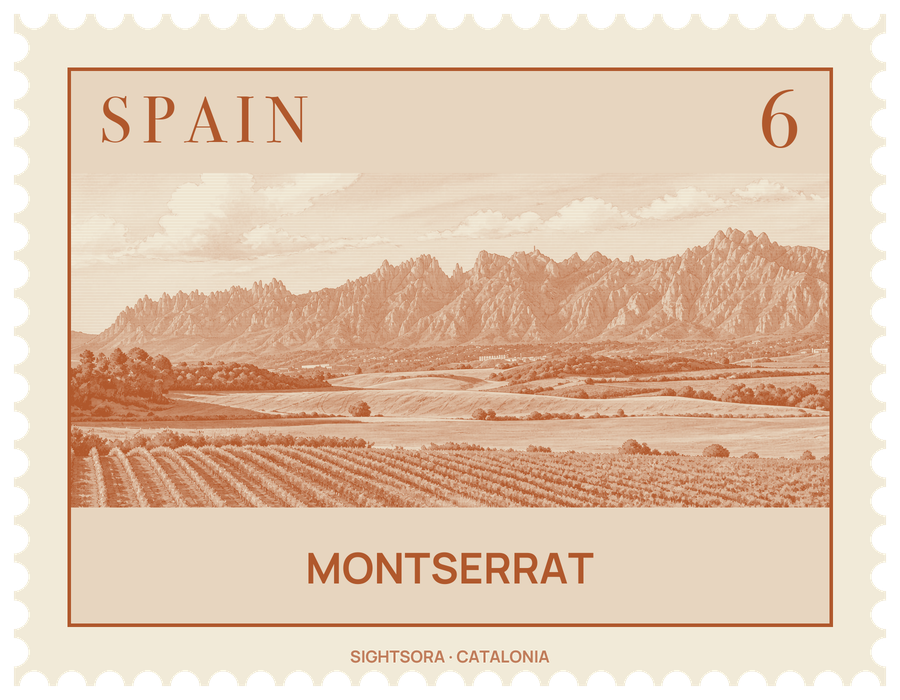
The highest is Sant Jeroni at 1,236 m, followed by Montgrós at 1,120 m and Les Agulles at 903 m. The name is Catalan for a mountain toothed like a saw, which is how the jagged skyline looks from far across the plain. It belongs to the Catalan Pre-Coastal Range and was given park protection in 1987.
For most visitors the reason to come is the Benedictine abbey of Santa Maria de Montserrat, set on the mountain itself. It is the sanctuary of the Virgin of Montserrat, the figure that gives the monastery its name and is known in Catalan as La Moreneta, "the little dark one". In 1493 Christopher Columbus named a Caribbean island after this same Virgin.
The rock is what makes the scenery. Montserrat is built of conglomerate, pebbles of mostly limestone held together by calcite, laid down during the middle Eocene in a fan delta on the edge of the Ebro Basin. Because it wore away more slowly than the softer ground around it, it was left standing as a mountain, and the carbonate in the stone has been dissolved into caves and karst towers.
Walkers and climbers have plenty to do among the pinnacles. A well-known route is the Canal de las Damas via ferrata, graded D, which climbs up a gully starting from the village of Collbató.