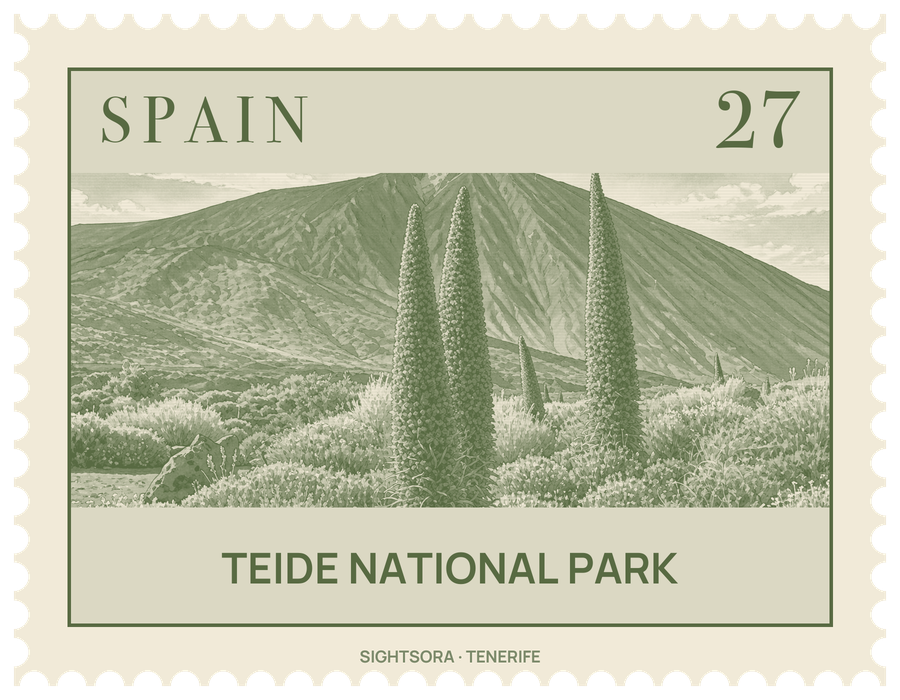
Its heart is the vast volcanic caldera of Las Cañadas, inside which rises the stratovolcano Teide-Pico Viejo; Pico Viejo, whose peak reaches 3,135 m, and Teide are the only two summits in the Canary Islands above 3,000 m. The park covers 18,990 hectares, all within La Orotava municipality. It was declared a national park on 22 January 1954 and a UNESCO World Heritage Site in 2007.
The landscape is made of volcanoes and lava flows in a wide range of colours and shapes. For the aboriginal Guanches the mountain was sacred, a place of worship they saw as the gate to hell, Echeyde, and important archaeological sites have been found in the park. Because of the altitude the climate is dry, with low humidity, strong winds, sparse and irregular rain and sharp differences between day and night; snow falls on some winter days. The scenery changes with the seasons, white and quiet in winter, full of colour in spring and parched in summer. At the Izaña observatory, at 2,371 metres, the sun shines for almost 3,500 hours a year.
The plants are built for harsh high-mountain conditions, and the vascular flora counts 168 species, 33 of them found only on Tenerife. Summit scrub dominated by Teide white broom (Cytisus supranubius) covers much of the ground, Teide bugloss (Echium wildpretii) raises pyramids of red flowers up to 3 m tall, and the Teide violet (Viola cheiranthifolia) grows on scoria and pumice above twenty-two hundred metres, right up to the summit. Most plants flower in May and June.
Invertebrates are the scientific treasure of the park: the park authority counts 44 % of the species as endemic to the Atlantic island groups that include the Canary Islands and 7 % as found nowhere outside the national park. Vertebrates are few. Three endemic reptiles live here, the Canary Island lizard, the Canary Island wall gecko and the Canary Island skink; ten bird species nest in the park, among them the blue chaffinch (Fringilla teydea teydea), a subspecies exclusive to Tenerife; and the only native mammals are bats. The terrain is close enough to that of Mars that in 2010 a Raman instrument for the ESA-NASA ExoMars mission was tested at Las Cañadas del Teide, and in 2017 ESA tested planetary rovers at Las Minas de San José. The telescopes of the Observatorio del Teide stand on a ridge east of the volcano.
Getting there
Coach trips through the park leave in the morning and in the afternoon from selected tourist towns in the south of Tenerife.