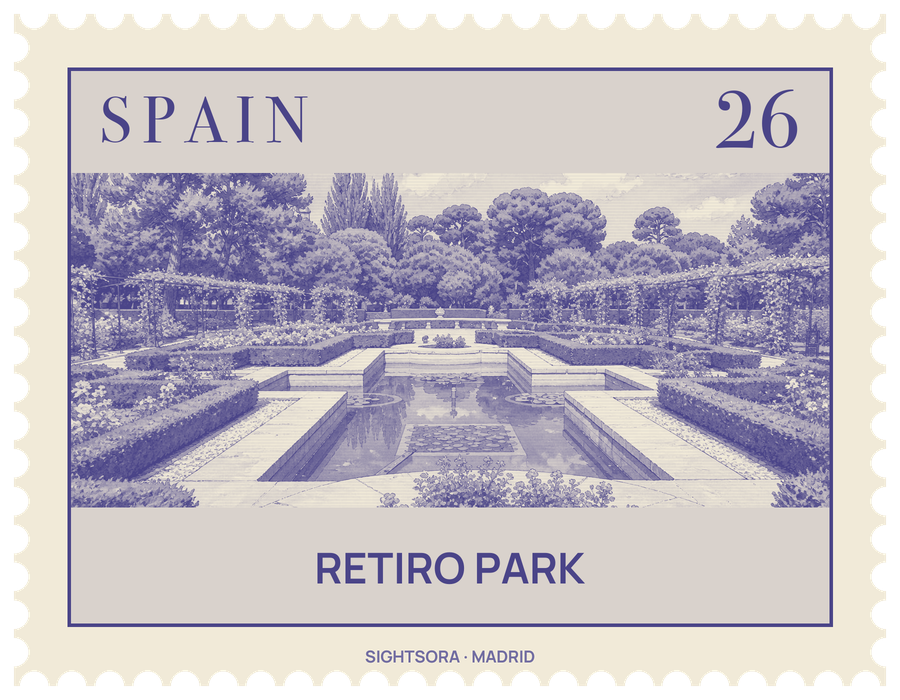
It began as a royal retreat and stayed in the hands of the Spanish monarchy until the Glorious Revolution of 1868 turned it into a public park. Since 2021 the park and the Paseo del Prado have together formed a UNESCO World Heritage cultural landscape, the Paisaje de la Luz.
The gardens took shape in the 1630s, when the Count-Duke of Olivares commissioned a new palace and grounds for the court; Cosimo Lotti, who had worked on the Boboli Gardens, organised them around water features such as the great pond and the great canal. The Peninsular War left most of the palace and its gardens in ruins, when French troops built the Citadel of Madrid on the grounds. Two palace buildings survive and now hold museum collections: the Casón del Buen Retiro, once a ballroom, and the Hall of Realms. Philip V added the Parterre, the park's only French-style garden, where an ahuehuete said to date from 1630 still grows.
The centre of activity is the Estanque Grande, where rowing boats can be hired; beside it stands the monument to Alfonso XII by José Grases Riera, an equestrian statue on a tall core ringed by a semicircular colonnade, with a viewpoint over the city. Two exhibition buildings serve as galleries of the Museo Reina Sofía: the Palacio de Velázquez of 1884 and the Palacio de Cristal, a glass pavilion by Ricardo Velázquez Bosco, built with its own pond for the Philippines Exposition of 1887 to show exotic plants. Near the Rosaleda, the rose garden, the Fountain of the Fallen Angel of 1922 carries Ricardo Bellver's statue of Lucifer falling from Heaven, inspired by Milton's Paradise Lost.
Other corners reward a slower walk: the Forest of Remembrance remembers the 191 people killed in the Madrid train bombings of 2004, the gardens of Cecilio Rodríguez follow a classical layout, and an olive tree estimated at 627 years old was planted near the Puerta del Ángel Caído in 2023. Runners, skaters and cyclists share the main paths, bicycles can be rented nearby, and kiosks and terraces offer a break. The park hosts the annual Book Fair and the San Isidro fireworks, and an audio guide with 38 stops, in Spanish, English and sign language, is reached through QR codes.
Getting there
Madrid's tourism office lists Retiro metro station at Calle de Alcalá 95 and Príncipe de Vergara station where Avenida de Menéndez Pelayo meets Calle de Alcalá.