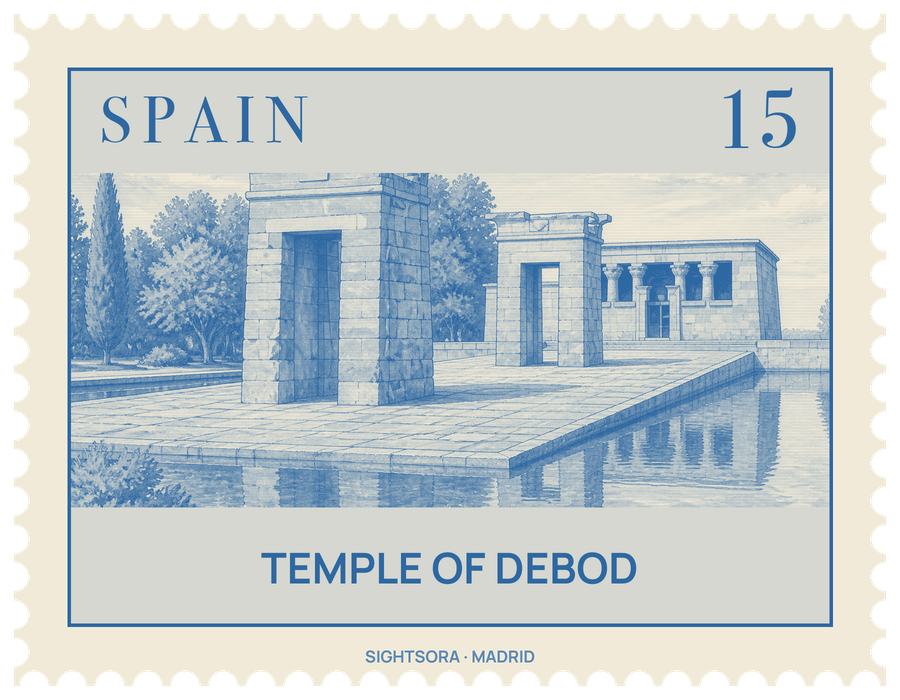
When the Aswan High Dam threatened the monuments of Nubia, UNESCO launched an international appeal in 1960, and in 1968 Egypt gave the temple to Spain in thanks for its help in saving the Abu Simbel temples. It was dismantled, shipped and rebuilt between 1970 and 1972, opening to the public in 1972, and it is the only work of its kind in Spain.
The temple grew in stages. Adikhalamani, the Kushite king of Meroë, began it as a single-room chapel to the god Amun. Under Ptolemy VI, Ptolemy VIII and Ptolemy XII it was enlarged on all four sides into a temple of 12 by 15 metres dedicated to Isis of Philae, and the Roman emperors Augustus and Tiberius completed the work.
Visitors approach along a processional way through stone pylon gateways to the temple itself. In Madrid the gateways were reassembled in a different order from the original; the one crowned by a sun flanked by serpents did not originally stand closest to the temple. The four-columned pronaos collapsed in 1868, so the building now opens onto the original sanctuary of Amun, then a room for offerings, and finally a later sanctuary with side rooms and a stair up to the roof.