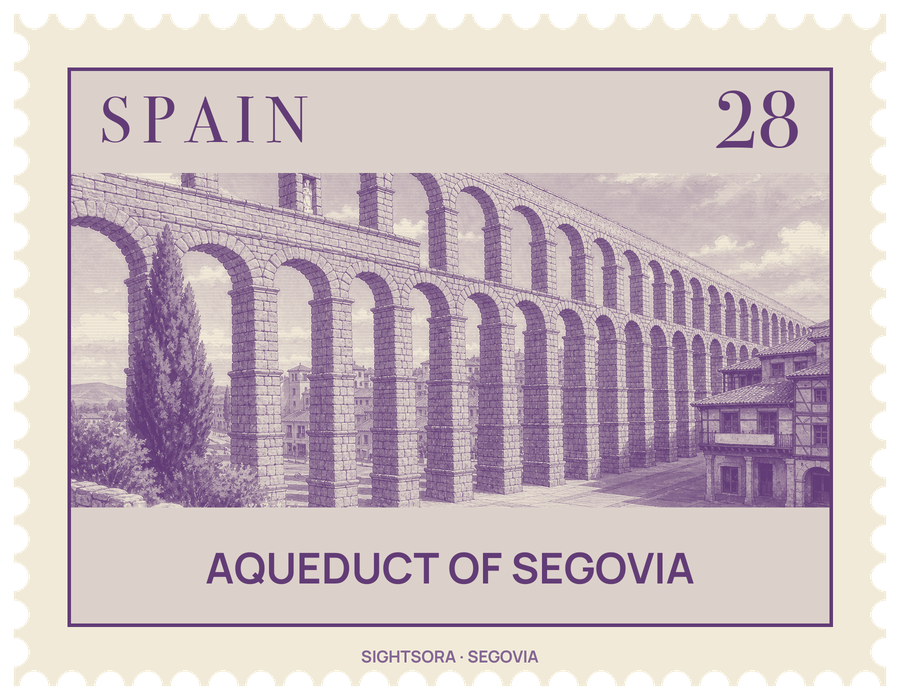
For many centuries it brought water from mountain springs to the city's fountains, public baths and houses, and it kept doing so until 1973. The aqueduct appears on Segovia's coat of arms, and in 1985 it was declared a UNESCO World Heritage Site together with the old town.
No legible inscription has survived, but study of the anchor holes left by the vanished bronze letters of its dedication, together with later archaeological evidence, places its construction under the Roman emperors in the late first or early second century AD. Its builders followed the principles set out by Vitruvius in De Architectura. The water was taken from the Rio Frio, in the La Acebeda area 17 km from the city, and ran for 15 km before reaching Segovia.
On the way the water collected in a tank called El Caserón, flowed on to a second tower, the Casa de Aguas, where sand was left to settle, and then covered 728 metres on a gentle one-percent slope to the Postigo, the rocky outcrop that carries the walled old town and its Alcázar. From there the arched bridge took over. At Plaza de Díaz Sanz the structure turns sharply toward Plaza Azoguejo, which is where it shows its full height. Inside the walls the water travelled underground, and the course of the main channel is marked on the city's pavements.
The arches stand in two tiers, the upper pillars shorter and slimmer than those below, and the water ran in a U-shaped channel along the top. Thirty-six arches of the first section, destroyed by the Moors in 1072, were rebuilt in the 15th century under the Catholic Monarchs in a project led by Don Pedro Mesa, who headed the Jerónimos del Parral monastery close by and took care not to alter the original style. Two niches face opposite sides of the aqueduct: one once held Hercules, the city's legendary founder, and now holds an image of the Virgin, while the statue of Saint Stephen in the other is lost. On 4 December, the feast of Saint Barbara, an image of the Virgen de la Fuencisla is wrapped in a flag by cadets from Segovia's military academy.
An interpretation centre about the aqueduct occupies one of the buildings of the Real Casa de Moneda, Segovia's old mint. The link between the two goes back a long way: coins struck in Segovia carried the aqueduct as their mint mark.