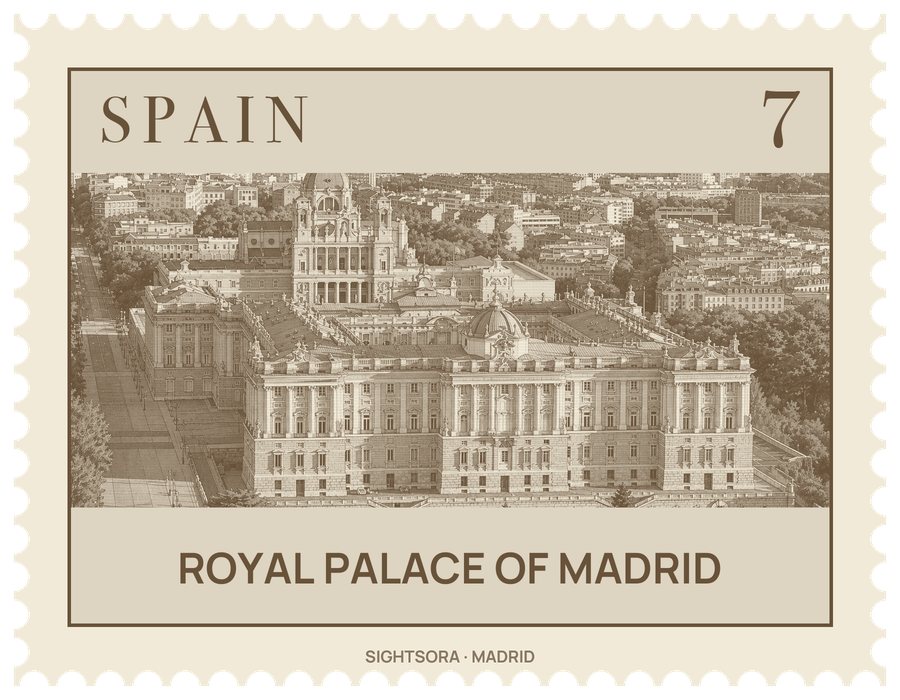
The Spanish royal family's official residence, it serves mostly for state ceremonies, and its 3,418 rooms spread over more than 135,000 m². The Spanish state owns it, and the public agency Patrimonio Nacional runs it.
The site has carried a royal building for more than a thousand years. A fortress raised between 860 and 880 by Muhammad I, the Umayyad Emir of Cordoba, grew into the Alcázar of Madrid, which Charles V and Philip II enlarged after Madrid became the capital in 1561. On Christmas Eve 1734 a fire that started in the rooms of the painter Jean Ranc burned for four days and destroyed it; Velázquez's Expulsion of the Moors was lost, while Las Meninas was saved by being thrown from a window. Philip V had the new palace built on the same spot between 1738 and 1755, to a design by Filippo Juvarra modelled on Bernini's unbuilt Louvre design and carried on by his pupil Sacchetti; Charles III first lived in it in 1764.
The main façade looks onto the Plaza de la Armería, with a rusticated base, Ionic columns over Tuscan pilasters and a balustrade along the top. Statues of saints and kings once lined that roofline; Charles III had them taken down, and many now stand in the gardens. Across the square is the Almudena Cathedral, built between 1878 and 1992. On the east side, the Plaza de Oriente links the palace to the Teatro Real, with box-hedged beds around the bronze Philip IV on horseback by Pietro Tacca and a row of limestone kings once meant for the palace roof.
The palace is too large to show all at once, so visitors see a rotating selection of rooms, and the palace closes during state functions. Highlights include the main staircase cut from a single piece of San Agustín marble, the Halberdiers' Room with a Tiepolo fresco, the Hall of Columns, and the Throne Room of 1772 under Tiepolo's Apotheosis of the Spanish Monarchy, its dual throne flanked by four bronze Medici lions. Other rooms hold Mengs ceiling frescoes, royal family portraits by Goya, a banquet hall created by Alfonso XII, and a room of instruments by Stradivari: a viola, two cellos and two violins.
Beyond the state rooms, the Royal Chapel of 1748 has ceiling frescoes by Giaquinto, and the Royal Library counts a Book of Hours that belonged to Isabella I of Castile among its treasures. The Royal Pharmacy displays jars from La Granja de San Ildefonso and Talavera de la Reina. The Royal Armoury, in a building opened in 1897, holds pieces from as early as the 13th century, including the armour Charles V wore at the Battle of Mühlberg and a shield and helmet made by the Negroli brothers, Francesco and Filippo.
Two gardens frame the palace. The Sabatini Gardens on the north side follow a symmetrical French layout around a rectangular pond and were begun in 1933 on the site of the old royal stables; they opened to the public in 1978. To the west, the Campo del Moro slopes down in the Romantic style, with the Triton fountain and the Fountain of the Shells lined up along its central path.
Getting there
The palace is on Bailén Street in central Madrid and is reached from Ópera metro station.