Francisco Goya is represented by more works than any other artist, and Hieronymus Bosch, El Greco, Rubens, Titian and Velázquez are among the other high points. Together with the nearby Thyssen-Bornemisza Museum and Museo Reina Sofía, the Prado forms the city's Golden Triangle of Art, and in 2021 UNESCO inscribed the Paseo del Prado as World Heritage.
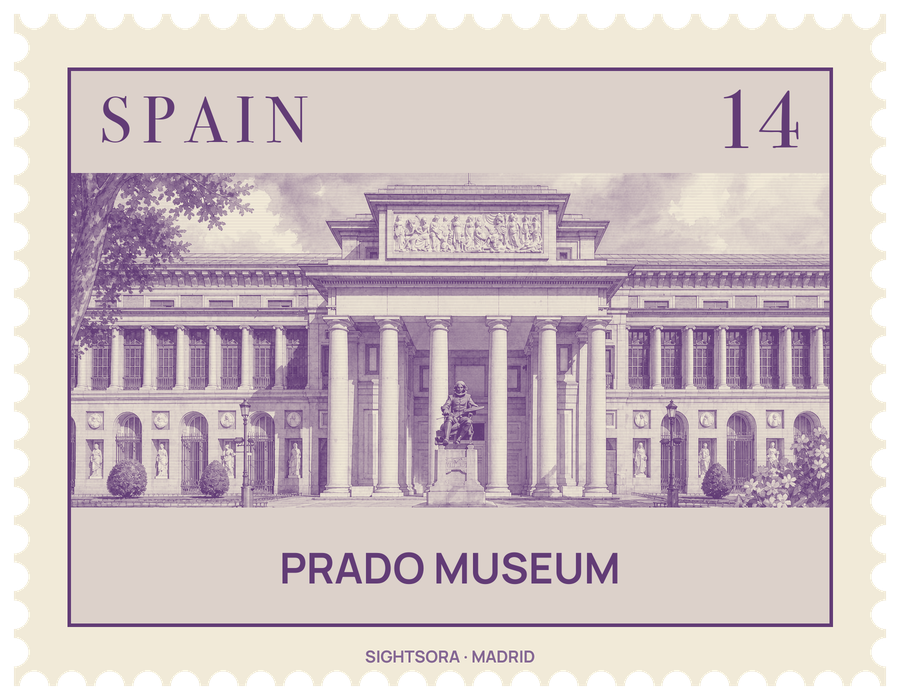
Juan de Villanueva designed the building in 1785 on the orders of Charles III, who meant it to house a Natural History Cabinet as part of a monumental remodelling of the Paseo del Prado; Villanueva also designed the nearby Botanical Garden. Work halted during the Peninsular War, when Napoleonic troops used the site as cavalry quarters and a gunpowder store. Ferdinand VII, urged by Queen María Isabel de Braganza, turned it into a royal museum of paintings and sculptures, which first opened to the public in November 1819. It was meant both to display the Crown's art and to show Europe that Spanish painting could stand beside any other national school. After Isabella II was deposed in 1868 the museum was nationalised and took the name Museo del Prado, after the meadow, or prado, that once covered the area.
The core of the collection grew from the 16th century under Charles V and the Habsburg and Bourbon kings who followed. That royal inheritance gives the Prado Las Meninas by Velázquez, The Garden of Earthly Delights by Bosch, Rogier van der Weyden's The Descent from the Cross, El Greco's portrait of a nobleman with his hand on his chest, Dürer's Self-portrait at 26, Rubens's The Three Graces and Goya's The Family of Charles IV. Much of its Italian painting reached Spain thanks to Velázquez himself. Other masterpieces arrived later, including Goya's two Majas, and in 1881 Barón Emile d'Erlanger donated Goya's Black Paintings.
Closed museums also fed the collection: the Museo de la Trinidad in 1872, which brought altarpieces by Pedro Berruguete and five canvases by El Greco, and, in 1971, the Museo de Arte Moderno, source of most of the 19th-century paintings, with works by the Madrazos, Vicente López, Eduardo Rosales and Sorolla. Purchases have continued with El Greco's The Fable and The Flight into Egypt, Goya's The Countess of Chinchon, a Bruegel and a Madonna of the Pomegranate by Fra Angelico. Only part of the collection hangs at any time; many works are lent to other museums and institutions.
The museum has grown beyond Villanueva's building. Rafael Moneo's extension, completed in 2007, links the main building underground to a reconstructed neighbour and placed the shops and cafeteria in a glass-roofed, wedge-shaped foyer to free space for galleries. The Casón del Buen Retiro and the Salón de Reinos, the former Army Museum, belong to the museum as well. A few metres away stand the Thyssen-Bornemisza and the Reina Sofía, while the Naval Museum, the Museo Arqueológico and the fine arts academy of San Fernando are also within reach.