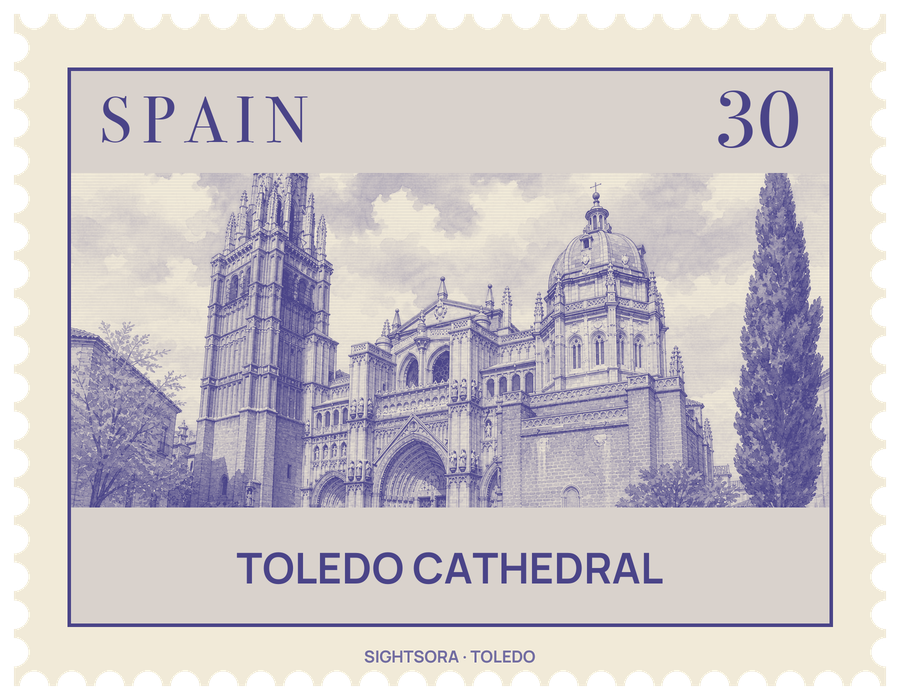
Its five naves follow the outline of the old mosque's prayer hall, and the cloister takes up part of the former courtyard. Pope Urban II recognised it as primatial in 1088, ranking it above the other sees of the Iberian Peninsula, and the cathedral presents itself as the most complete compendium of the faith, history and art of a nation.
Modelled on Bourges Cathedral and built of white limestone from the Olihuelas quarries near Toledo, the church is 120 metres long, 59 metres wide and 44.5 metres high, with a transept and a double ambulatory. In the sanctuary, Mudéjar triforia survive, with cusped arches below and interlaced arches above. The single tower, 92 m tall, stands to the left of the main façade: Alvar Martínez built its square lower stages and Hanequin de Bruselas its octagonal top, finished with a spire bearing three crowns like a papal tiara. A matching tower was planned on the right, but the ground there sat over an underground stream, and the Mozarabic Chapel was built in its place.
The main façade has three doorways. The central Puerta del Perdón, begun in 1418, opens only on special occasions and for the arrival of a new archbishop; its tympanum shows the Virgin handing a chasuble to Saint Ildephonsus, a scene repeated again and again inside. On the north side, the Portal of the Clock, begun in the 14th century, tells the life of Christ in four bands of carving beneath a 13th-century rose window that holds the cathedral's oldest stained glass. The Portal of the Lions, made between 1460 and 1466 by Hanequin of Brussels, his son Enrique de Egas Cueman and Flemish sculptors including Juan Alemán, takes its name from the lions on the columns of its gate.
Inside, the main chapel is dominated by a towering late Gothic altarpiece, commissioned by Cardinal Cisneros and made between 1497 and 1504, five panels wide and five storeys tall and crowned by the Crucifixion; around it lie the tombs of Alfonso VII, Sancho III and Sancho IV and the Renaissance sepulchre of Cardinal Mendoza. Behind the high altar, in the ambulatory, is El Transparente, a Baroque work in marble, bronze, stucco and paint by Narciso Tomé and his four sons, made in 1729-1732: a skylight cut high in the wall and an opening in the back of the altarpiece let sunlight fall on the tabernacle. The choir is the work of Berruguete and Vigarny, and light enters through more than 750 windows of stained glass made between the 14th and 16th centuries.
The sacristy, under a vault painted by Luca Giordano, works as a picture gallery: among its fifteen paintings by El Greco is El Expolio on the altar, and works by Goya, Titian, Velázquez, Caravaggio and van Dyck hang nearby. The treasury keeps the Custodia of Enrique de Arfe, a monstrance more than ten feet tall made between 1517 and 1524 in the shape of a Gothic temple with 260 statuettes, carried through the streets in the Corpus Christi procession since 1595. The Mozarabic Chapel, under a dome designed by El Greco's son Jorge Manuel Theotocópuli, still holds services in the Hispano-Mozarabic Rite, and the Chapel of Saint Blaise, off the cloister begun in 1389, keeps frescoes attributed to Florentine painters.