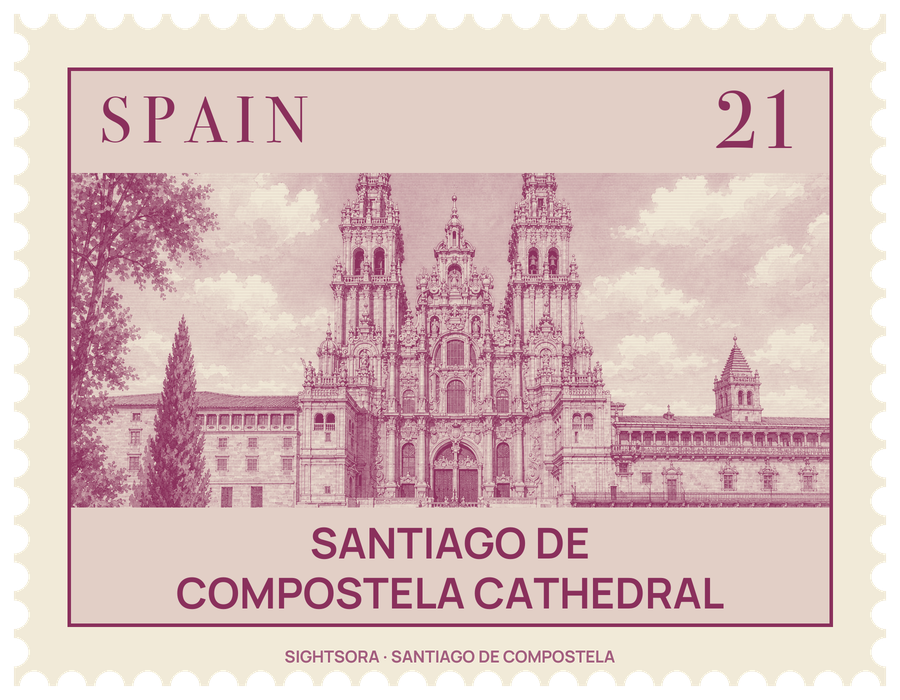
Legend says a hermit named Pelagius found the tomb in 814 after seeing lights in the night sky over the Libredon forest, and King Alfonso II of Asturias had a chapel built over it. Al-Mansur's army burned the early church in 997 but left the tomb alone. The present Romanesque building was begun in 1075 and consecrated in 1211, and Gothic and Baroque additions followed; the cathedral is included in the city's World Heritage listing.
Each of the four façades opens onto its own square. The west front facing the Praza do Obradoiro, named after the stonemasons' workshop that once stood there, is a Baroque screen finished by Fernando de Casas Novoa in 1740 to shield the older Romanesque portal behind it from the weather. Saint James stands in the centre dressed as a pilgrim, with his disciples Athanasius and Theodore below, between the bell towers known as the Torre das Campás and Torre da Carraca. A diamond-shaped double staircase from the 17th century climbs to the entrance and wraps around the door to the 12th-century crypt called the Old Cathedral. This façade is engraved on the back of Spain's 1, 2 and 5 cent coins.
On the south side, the Pratarías façade, built between 1103 and 1117, is the only Romanesque façade to survive; among its carvings is a King David with crossed legs playing a stringed instrument, the work of Master Esteban. The north façade, the Acibecharía, was rebuilt after a fire in 1758 and completed in 1769. On the east, facing the Plaza de la Quintana, the Porta Santa, or Holy Door, is opened only in Jacobean holy years, which are set by the weekday on which the saint's feast of 25 July falls. The Clock Tower, or Berenguela, rises 75 metres above the corner of the two squares; its lantern is lit throughout holy years as a beacon for pilgrims.
Just inside the west front stands the Pórtico da Gloria, carved by Master Mateo and his workshop and dated 1188. Its three arches match the three naves of the church. Christ in Majesty fills the central tympanum, surrounded by the evangelists, angels carrying the instruments of the Passion and the Elders of the Apocalypse holding musical instruments; Saint James sits on the central column with a pilgrim's staff above a Tree of Jesse. Apostles and prophets line the columns, the right-hand arch shows the Last Judgment and the left one Old Testament figures. Facing the altar at the foot of the central column kneels a small figure of Mateo himself, known as the Santo dos Croques because students used to knock their heads against it for wisdom.
The interior keeps its Romanesque cross-shaped plan, with a barrel-vaulted nave, side aisles, a wide transept and galleries running high above the aisles. A huge baldachin rises over the main altar with a 13th-century statue of Saint James, and pilgrims can reach it through a narrow passage behind the altar to kiss the saint's mantle. The crypt beneath holds the silver reliquary made by José Losada in 1886 for the relics, which were rediscovered in 1879. The radiating chapels hold paintings, altarpieces and reliquaries, including a gold crucifix dated 874 in the Chapel of the Reliquary.
On important feast days and at pilgrims' masses in Jubilee years, the Botafumeiro, a censer made by Losada in 1851, weighing 80 kg and standing 1.6 metres tall, is hung from a pulley in the dome above the crossing and filled with charcoal and incense. Eight men in red robes, the tiraboleiros, haul on the ropes until it swings almost to the roof of the transept. At other times it is kept on display in the cathedral library.