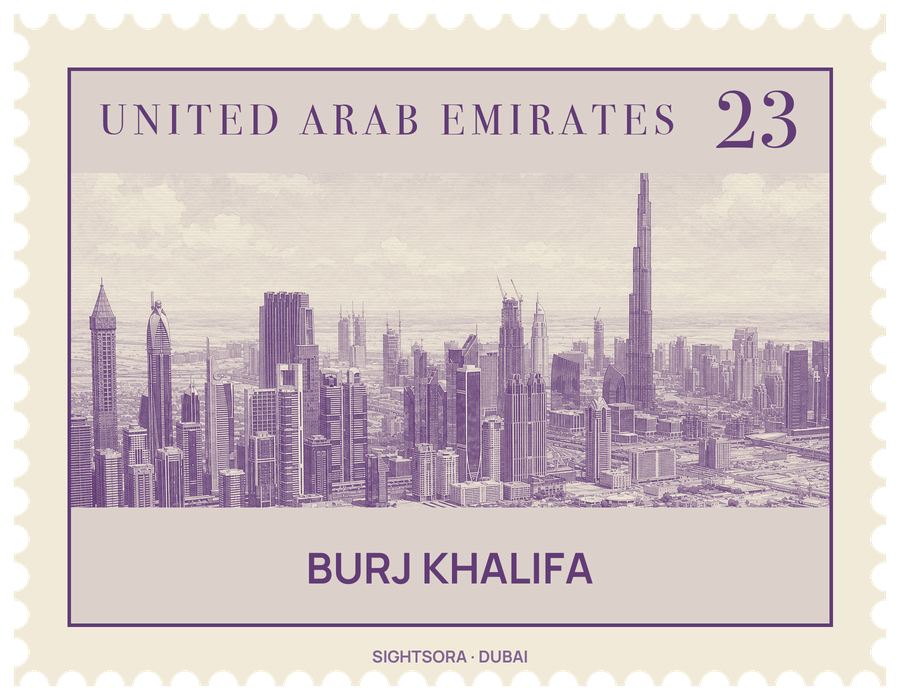
It was planned by Emaar Properties as the centrepiece of a new district that also took in the Dubai Mall, hotels, apartment towers, parkland and an artificial lake of 12 hectares. Work started on 12 January 2004, the exterior was finished on 1 October 2009 and the tower opened on 4 January 2010. Until that day it was called Burj Dubai; at the ceremony it was renamed after Khalifa bin Zayed Al Nahyan, the UAE president whose government had arranged financial help for Dubai during the Great Recession.
The Chicago firm Skidmore, Owings & Merrill designed it; Adrian Smith led the architecture and Bill Baker the structural engineering. The plan is a Y of three wings around a buttressed central core, a form that draws on the Islamic architecture of the region; the park at its foot shares the tower's inspiration in the Hymenocallis, a desert flower. Climbing the shaft, 27 setbacks step inward in a spiral, shrinking the floor plate, breaking up the wind and leaving terraces on the way, until the core itself emerges as the spire. That spire alone holds more than 4,000 tonnes of steel; without it the building would stand 585 metres. Over 26,000 reflective glass panels clad the outside, and some of the tower's steel was salvaged from Berlin, where the Palace of the Republic had been torn down.
Inside, the floors are stacked by use. An Armani Hotel of 304 rooms fills 15 of the lower 39 floors, floors 20 to 108 hold 900 private apartments, and swimming pools sit in the sky lobbies of the 43rd and 76th floors. Visitors ride double-deck lifts, fitted with LCD screens for the journey, to the At the Top observation deck on the 124th floor at 452 metres, where an augmented-reality telescope can show the view as it looks at other times of day or in other weather. Higher up are the SKY level on the 148th floor at 555 metres, opened in 2014, and The Lounge at 585 metres, opened in 2019, while a restaurant occupies the 122nd floor. On a clear day with a low tide, the coast of Iran, about 153 km away, can be made out from the top.
The height changes even the clock: the sun stays visible for minutes after it has set in the streets below, so residents above the 80th floor break the Ramadan fast two minutes later than those on the ground, and above the 150th floor three minutes later. At the base, an eleven-hectare park by SWA Group centres on the water room, a run of pools and jets, and is watered with condensate collected from the tower's air conditioning. Beside it lies the Dubai Fountain, 270 metres long, lit by 50 coloured projectors and 6,600 lights, firing water up to 150 metres high to music that ranges from classical to contemporary Arabic. Every 31 December Emaar marks the new year here with fireworks launched from the tower, a light and laser show on its façade and a matching fountain show.