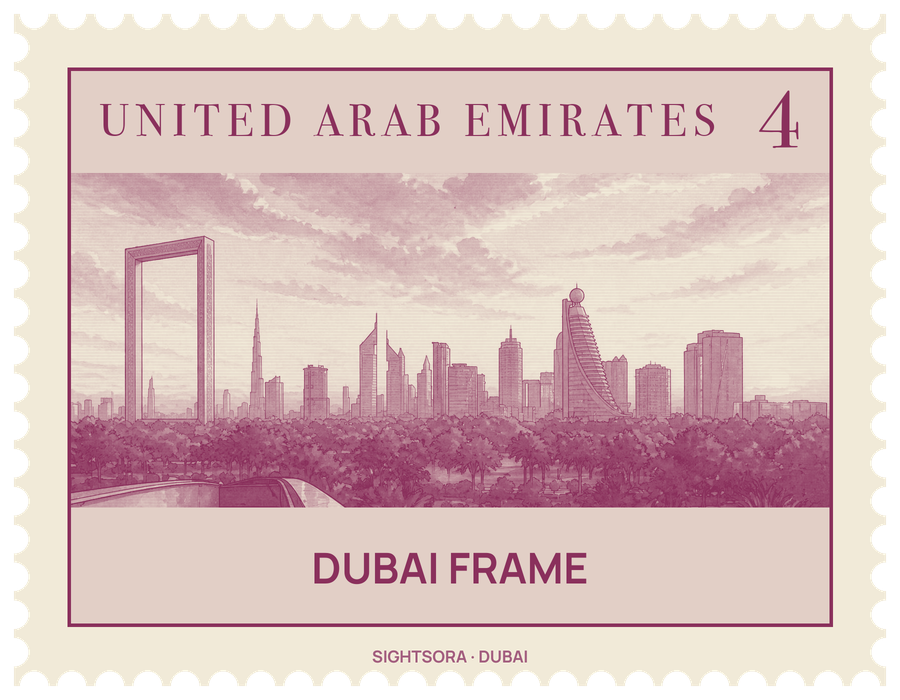
It rises 150.24 metres and spans 95.53 metres, built of steel, glass, reinforced concrete and aluminum, and the logo of Expo 2020 is worked into its outer facade, and its proportions follow the golden rectangle ratio of 1:1.618. It opened in January 2018.
The idea came from the architect Fernando Donis, whose entry won the 2009 ThyssenKrupp Elevator International Award, chosen from 926 proposals in a competition for a new emblem of Dubai. His reasoning was that a city already full of emblems did not need one more; instead he proposed an empty frame, 150 metres by 105 metres, that would keep framing Dubai as it changed. The building was later redesigned and completed by Hyder Consulting, part of Arcadis, and Donis, who said he had been denied credit, took Dubai Municipality and ThyssenKrupp Elevator to a United States federal court in December 2016; the case reached no conclusion.
The visit begins in the lower span, where a museum uses special effects to trace the city's story from a nomadic settlement of fishing and pearl diving onwards, and a video exhibit projects Dubai 50 years into the future. A lift then climbs 48 floors in 75 seconds to the Sky Deck across the top, where glass-bottomed floors look straight down almost 150 metres to the lower span. To the south, the deck faces modern Dubai and the towers along Shaikh Zayed Road; to the north lie the older neighbourhoods of Deira, Umm Hurair and Karama.