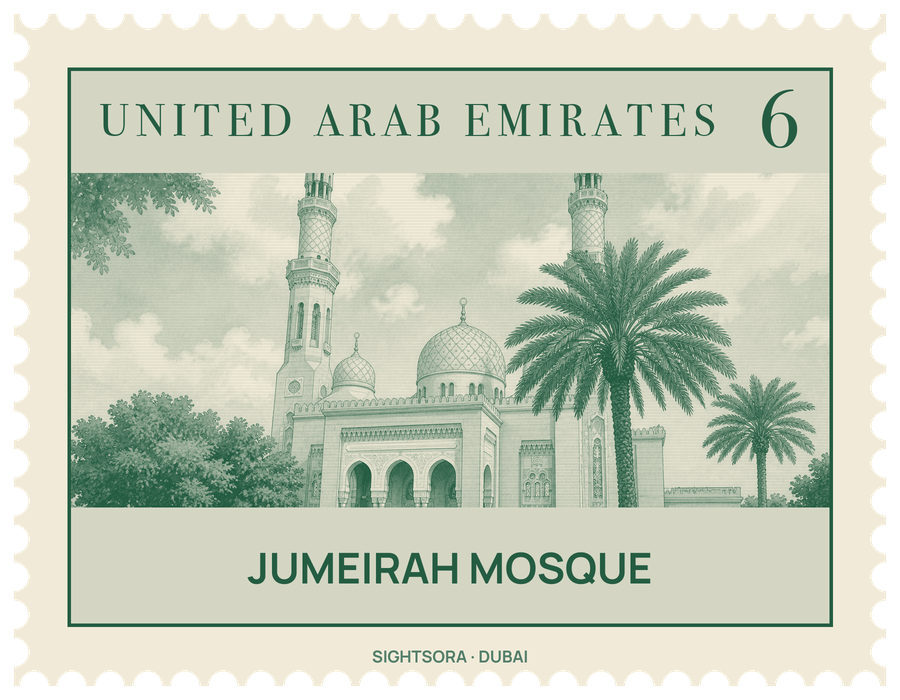
Construction ran from 1975 until the opening in 1979, a gift from Sheikh Rashid bin Saeed Al Maktoum, then Ruler of Dubai, to Sheikh Mohammed bin Rashid Al Maktoum, his son and heir. It holds up to 1,200 worshippers, and its image appeared on the 500 dirham banknote of the 2003 series.
The design came from Hegazy Engineering Consultancy of Cairo, whose architects were Muhammad al-Mahdi Hegazy and Abd al-Muʿizz Husayn, and it borrows from the medieval Islamic architecture of that city: official descriptions name the Fatimid style as the model, while the carved stonework also recalls Mamluk buildings. There are two entrances, one used by visitors and one on the far side for those coming to pray, where Quranic inscriptions from Surah At-Tawbah frame the door. Fountains for ablution stand in the outer courtyard.
Inside, columns stand around the central dome in a hypostyle plan, and a large carpet with floral patterns covers the floor. The walls are painted in bands that rise from beige through yellow and salmon pink to blue, which continues over the dome like a sky; the ornament shows clear visual echoes of the Alhambra in Spain. An inscription of the Victory verse of the Qur'an runs through the prayer hall.
Jumeirah Mosque is one of the few mosques in Dubai that non-Muslim visitors can enter, and they do so on guided tours organised by the SMCCU, the Sheikh Mohammed Centre for Cultural Understanding; the mosque has welcomed visitors this way since 1998, as part of a programme called "Open Doors. Open Minds." The tours are less about the building than about Islam and Arab culture: Muslim guides from many backgrounds explain the Five Pillars, ablution and the basics of prayer, and each session ends with open questions and answers. The complex also includes a majlis, a traditional sitting room, with a gift shop.