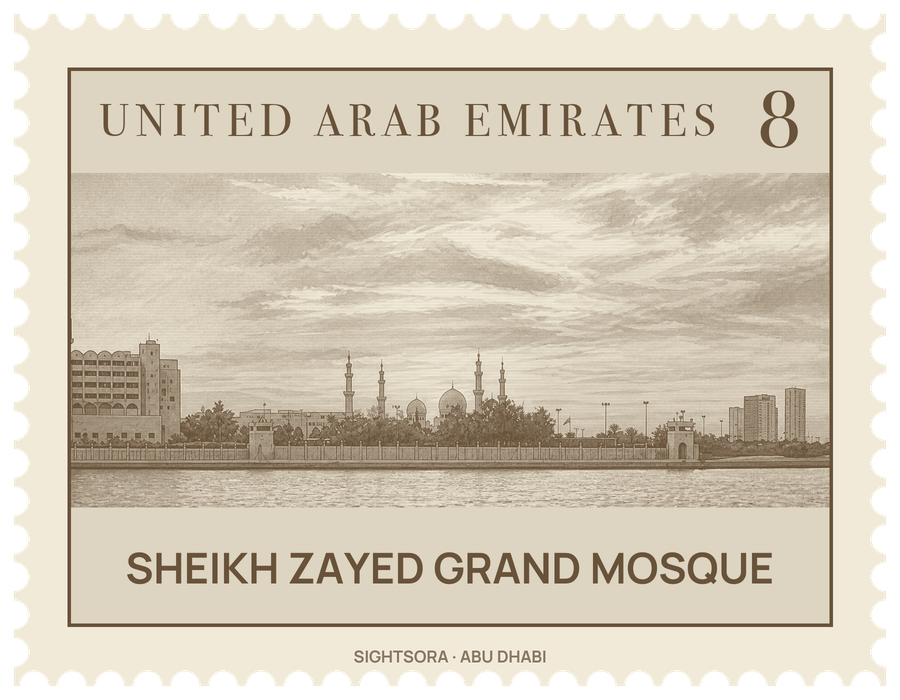
It was built between 1994 and 2007 and inaugurated in December 2007. The project was launched by Sheikh Zayed bin Sultan Al Nahyan, the late president of the UAE, who wanted a building that would draw together the cultural diversity of the Islamic world; he died in 2004 and lies buried in the courtyard.
The Syrian architect Youssef Abdelke led the design with Imad Malas, Basem Barghouti and Moataz Al-Halabi. They took the floor plan and dome layout from the Badshahi Mosque in Lahore and also looked to Alexandria's Abu al-Abbas al-Mursi Mosque and to Persian, Mughal and Indo-Islamic buildings; the arches are Moorish in character and the minarets Arab. The building carries 82 domes, and its main axis is turned about 12° south of true west so that it faces the Kaaba in Mecca. Craftsmen and materials came from many countries, among them Syria, India, Italy, Germany, Turkey, China and North Macedonia, whose Sivec marble from Prilep clads the exterior.
The courtyard, some 17,000 square metres, is paved in marble mosaic designed by the British artist Kevin Dean, with tulips, lilies and irises from the Middle East curling in from the edges. More than a thousand columns line the outer arcades: 1,096 six-sided shafts faced with white marble and inlaid with semi-precious stones in the pietra dura manner, every piece carved and set on site, and crowned by golden capitals of anodized aluminum shaped like the fronds of a date palm. Ten rectangular pools, tiled in shades of blue and holding nearly 7,000 square metres of water, run around the building and mirror the arcades.
The main prayer hall holds more than 7,000 worshippers. Its floor is covered by a single hand-knotted carpet of 5,627 square metres, designed by the Iranian artist Ali Khaliqi and made mostly of wool by around 1,200 knotters over roughly two years, and seven chandeliers from Faustig of Munich, set with Swarovski crystals, hang in the mosque, the largest 10 metres across and 15 metres tall. The 96 columns of the hall are inlaid with mother of pearl. On the qibla wall, the 99 names of God appear in Kufic script by the Emirati calligrapher Mohammed Mandi Al Tamimi, softly lit by fibre optics, and at its centre the semicircular mihrab is covered in golden glass mosaic that seems to flow down from a beehive-like crown, an image of the river of honey that the Quran places in paradise.
After dark, a lighting scheme by Speirs and Major Associates throws bluish-grey clouds across the white walls, brightening and dimming with the phases of the moon, and the Sura night tours are built around this effect. The Sheikh Zayed Grand Mosque Centre, with offices in the west minarets, leads cultural tours in Arabic and English, and the Al Deleel multimedia guide offers tours in 14 languages. Beyond the mosque itself, the Light & Peace Museum presents Islamic civilisation through science, arts and literature in five galleries, Diya is a 360-degree immersive show about the mosque's message, and the Souq Al Jami' has shops, cafés and restaurants looking out on the building. A library in the north-east minaret keeps books on Islamic sciences, calligraphy, arts and coins in many languages.