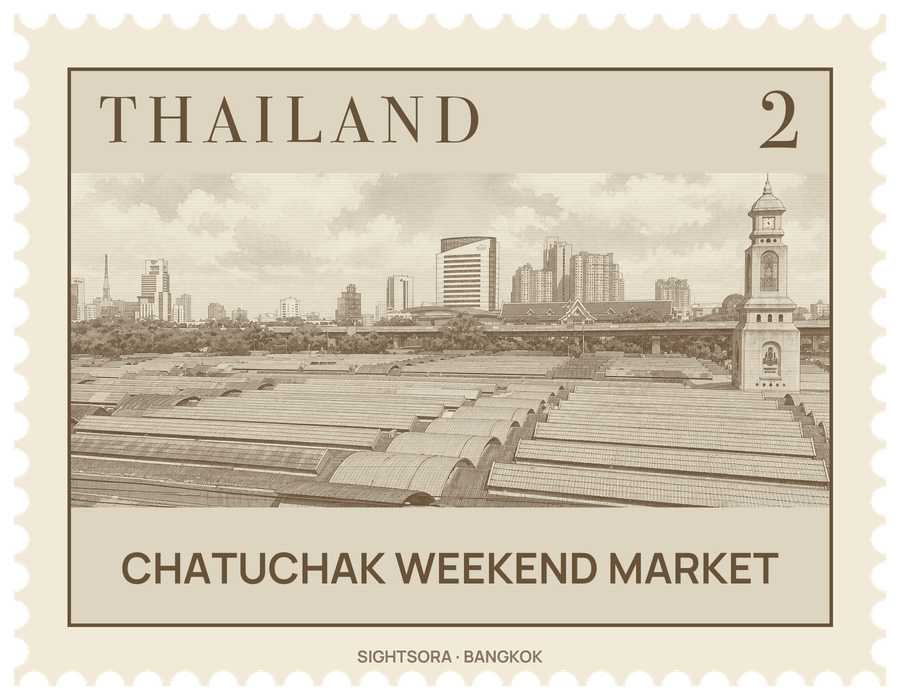
Locals call it JJ Market. Under its roofs are plants, antiques, ceramics, furniture, clothing, books, cosmetics, electronics, pets, and fresh and dry food, and more than 200,000 people come through every weekend.
The market has a longer and more mobile history than its site suggests. It began in 1942, was placed at Sanam Luang in 1948 when Prime Minister Plaek Phibunsongkhram required every province to have its own market, moved briefly to Sanam Chai and returned to Sanam Luang in 1958. From 1975 General Kriangsak Chamanan, then chairman of the State Railway of Thailand, let a new market use railway land south of Chatuchak Park, built up with landfill from the Din Daeng Garbage Mountain. By 1983 every merchant had moved here; it was first known as Phahonyothin Market and took the name Chatuchak Market in 1987.
The clock tower at the centre is the market's landmark and the easiest meeting point in the maze. It was put up in 1987 for the 60th birthday of King Bhumibol Adulyadej, a joint project of the market administration and the Thai-Chinese Merchant Association.
Section numbers help with finding a way around. Art and galleries are grouped in section 7; antiques and collectibles in sections 1 and 26; handicrafts in sections 8 to 11; plants and gardening in sections 3 and 4; and ceramics in odd-numbered sections including 11, 13, 15 and 17. Clothing and accessories take up most of the sections from 10 to 26, while food and drink stalls cluster in sections 2 to 4 and 23 to 27. Pet stalls sit in sections 8, 9, 11 and 13; a 2015 survey there counted 1,271 birds of 117 species on sale, several of them threatened, and studies have linked the market to illegal trade in endangered wildlife.
Getting there
Two stations on the MRT Blue Line serve the market: Kamphaeng Phet at its western end and Chatuchak Park at its eastern end. Mo Chit station on the BTS Sukhumvit Line is also close to the eastern end.