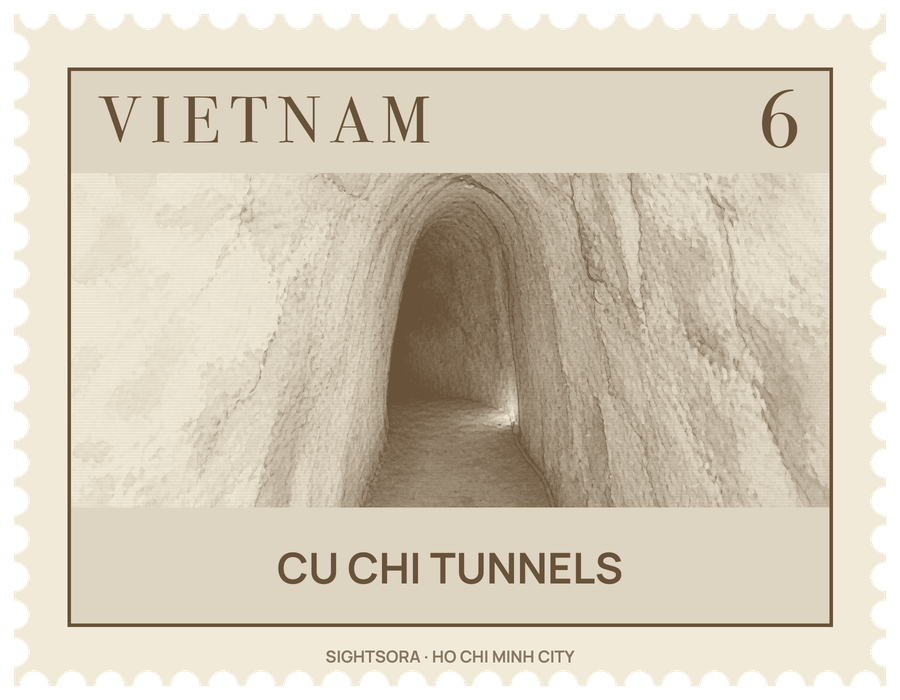
The Củ Chi tunnels served as the base from which the Tết Offensive of 1968 was organised. After reunification the government preserved the 121-kilometre complex as a war memorial park.
Life underground was hard. Air, food and water were scarce, ants, centipedes, scorpions, snakes and rodents shared the passages, and malaria was the second cause of death after battle wounds. Fighters usually stayed below by day and came up at night to farm, gather supplies or fight, and during heavy bombing they could be trapped underground for days. The tunnels were built with trap doors, ventilation shafts to let out smoke and gas, and bamboo traps for anyone who broke in.
American and allied forces tried repeatedly to destroy the network. In Operation Crimp, which began on 7 January 1966, B-52 bombers turned the jungle into a cratered landscape and some eight thousand troops searched the area, but gas, water and grenades thrown into the entrances did little. An Australian engineering troop under Captain Alexander MacGregor then went inside and spent four days searching, finding ammunition, radios, medical supplies and food; one of them, Corporal Robert Bowtell, died in a dead-end tunnel. Volunteer "tunnel rats" armed with a handgun, a knife and a flashlight were trained after that, and in 1967 Operation Cedar Falls, with 30,000 troops, uncovered the Viet Cong district headquarters and half a million documents. Later carpet bombing collapsed some sections but could not destroy most of the system.
Visitors can see the tunnels at two sites. Bến Dược contains part of the original network, while Bến Đình, closer to Ho Chi Minh City, has reconstructed tunnels, some widened so that visitors can fit through. Both have low lighting inside the passages and displays of the different booby traps, and restored underground conference rooms show where the Tết Offensive and other campaigns were planned. Visitors are invited to crawl through the safer stretches. A film shown on site presents the Viet Cong fighters in heroic terms.