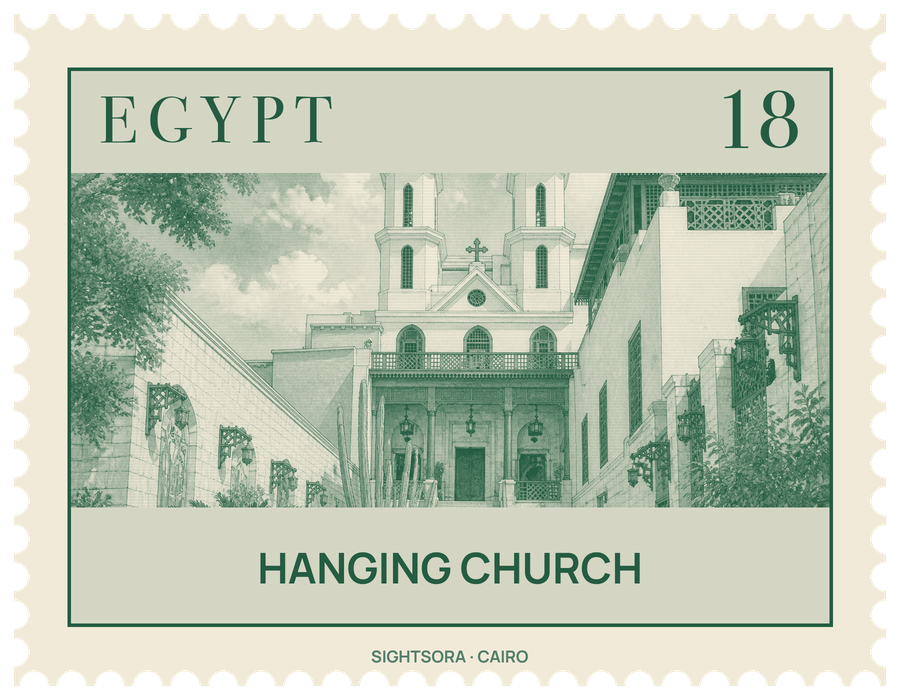
Early travellers called it the Staircase Church after the twenty-nine steps that climb to its door. The ground has risen by some six metres since Roman times, so most of the Roman tower is now buried and the church looks less lofty than it once did.
The church is part of the Coptic Orthodox Church of Alexandria, and its history is long and layered. The first written mention comes from the time of the patriarch Joseph I in the 9th century; in 840 the governor Ali ibn Yahia partly destroyed it, and for a period it served as a mosque before being reconsecrated in the tenth century. Pope Abraham largely rebuilt it in the 970s, and in 1047 the Coptic Pope made the church his fixed residence when the patriarchal seat moved from Alexandria to Cairo. Patriarchs were selected and some were buried here, and the date of Easter was set within its walls.
The approach is part of the experience. From the street, visitors go in under a pointed stone arch fitted with iron gates, cross a narrow courtyard decorated with modern biblical designs and face a 19th-century façade with twin bell towers. The steps lead up to a second small courtyard and an outer porch from the eleventh century. Beneath the church lies the old atrium entrance of the fortress, its walls cut with niches that once held statues.
Inside, the main church follows a basilica plan within a rectangular outer wall, ending in three apses. It is dedicated to the Virgin Mary and has sanctuaries to her and to Saints John the Baptist and George. The pulpit stands on 15 columns set on a white marble slab, and a carved beam over the entranceway is dated to 284, the year that begins the Coptic era. Around the walls hang 110 icons, most of them from the 18th century, the oldest from the 8th. To the south, the older and smaller church holds chapels, a baptistery and mosaics set in a hollow in its south wall.
Church tradition links several apparitions of the Virgin Mary to this place, among them the dream in which she is said to have appeared to Pope Abraham in the story of Simon the Tanner and the moving of the Mokattam Mountain. The building has needed repeated care: a ceiling collapse in 1983 and the 1992 earthquake damaged it, and a restoration begun in 1998 was completed in 2011. Some of its older treasures went to the Coptic Museum, and a set of carved wooden door panels from 1300 is in the British Museum.