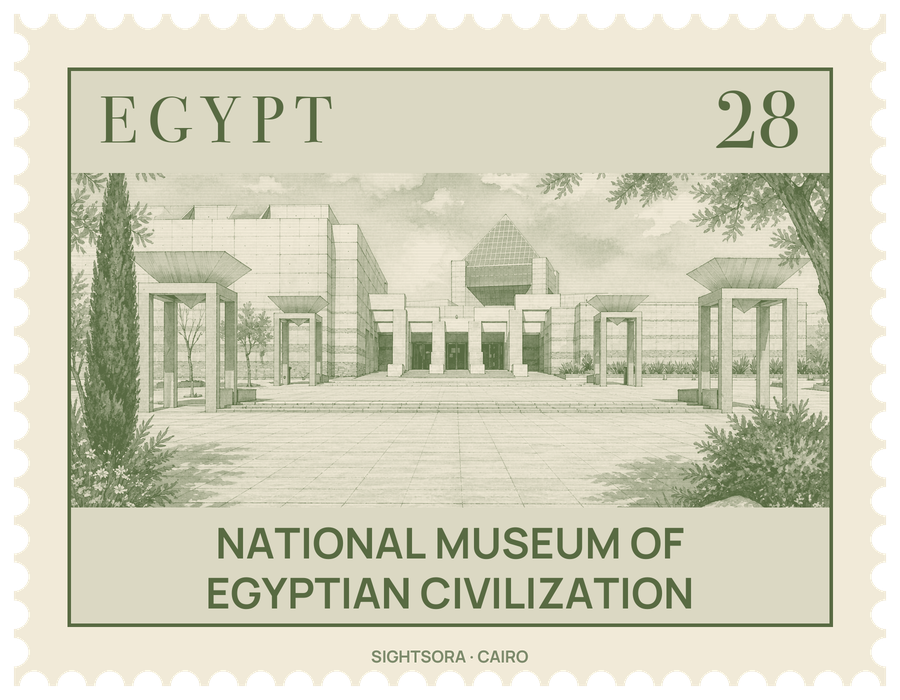
It opened in part in 2017 and was formally inaugurated on 3 April 2021, when the royal mummies, among them those of 18 kings, were brought over from the Egyptian Museum downtown in a procession called the Pharaohs' Golden Parade. Its collection runs to about 50,000 objects, and UNESCO gave technical help in setting it up.
The Royal Mummies' Hall is laid out to evoke the Valley of the Kings, the original resting place of most of the rulers it now holds. The kings and queens on show come from the 17th to the 20th dynasties, among them Ramesses II and Queen Tiye. Other royal pieces in the museum include a chair of Queen Hetepheres I, mother of Khufu, a chariot of Thutmose IV, and a statue of Horus and Thoth purifying Amenhotep II.
The permanent displays are arranged both by period, from the Archaic and Pharaonic eras through the Greco-Roman, Coptic, medieval and Islamic periods to the present, and by theme, with sections on the Nile, on writing, on beliefs and thinking, on state and society, on material culture and on the dawn of civilization. The main gallery gives an overview of the whole span, with pieces such as the coffin of Sennedjem, the Nazlet Khater skeleton, the Nilos statue, the Al Falaha statue, the Tent of Purification and the minbar of Aboubakr Ibn Mizhar. A textile gallery shows around 600 pieces, and the museum also preserves an old dye house from the Fatimid period, a rare survivor of the dye works of old Cairo.