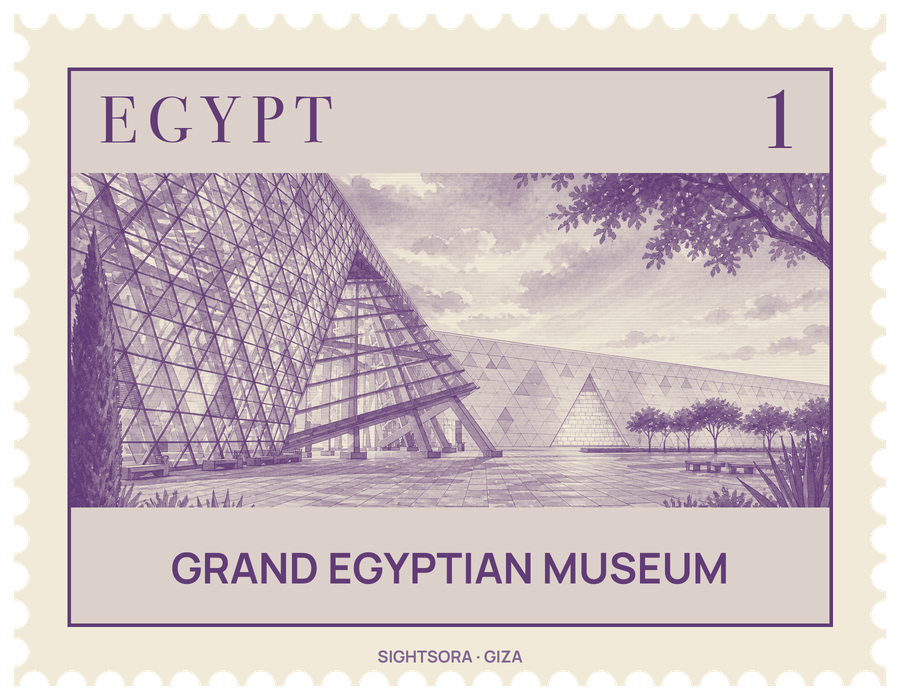
The building is a chamfered triangle fronted by a plaza of date palms and a façade of translucent alabaster, and its north and south walls are oriented towards Khufu's Great Pyramid and Menkaure's pyramid. First announced in 1992, with building work starting in 2005, it was formally inaugurated on 1 November 2025.
The entrance leads into the Atrium, a hall of 10,000 square meters under a glass roof, with the pyramids in view through its transparent front. Its centrepiece is a colossal statue of Ramesses II, 11 metres tall, which was taken from Ramses Square in Cairo in 2006 and set up here in 2018. From the Atrium the Grand Staircase, six stories high, works as a gallery in its own right: more than 60 royal statues, temple sculpture, figures of gods and stone sarcophagi line the climb to the main halls and to an upper terrace that looks out again towards the pyramids.
The 12 main galleries show over 24,000 objects in time order, from about 3100 BCE to 400 CE, brought together from storerooms and museums in Cairo, Luxor, Alexandria and other parts of the country. The first three halls run from prehistory through the Old Kingdom, the next three cover the Middle Kingdom, halls 7 to 9 the New Kingdom, and the last three the Third Intermediate and Late periods and the Greek and Roman era. The Middle and New Kingdoms take up the most space.
Two of these halls are reserved for Tutankhamun, and for the first time all 5,398 objects from his tomb can be seen in one place; the Egyptian Museum in Tahrir Square only ever showed part of them. The golden mask is the focus, near his three nested coffins, one of gold weighing 110 kg and two of gilded wood, and the Golden Throne, sheathed in gold and silver with scenes of the king and his wife Ankhesenamun. Around them are jewellery and amulets, daggers and bows, beds and chairs, and the small ushabti figures meant to serve him in the afterlife, in halls laid out to recall his tomb in the Valley of the Kings, where his mummy has stayed.
A separate hall, the Khufu Ships Museum, is devoted to the two wooden boats buried beside the Great Pyramid for its builder, about 4,600 years old; they were moved here in August 2021 from the old boat museum at Giza. Displays explain what they may have been for, perhaps carrying the king into the afterlife or travelling with the sun god Ra. The complex also includes a Children's Museum built around play, interactive screens and augmented reality, and four halls for temporary exhibitions.